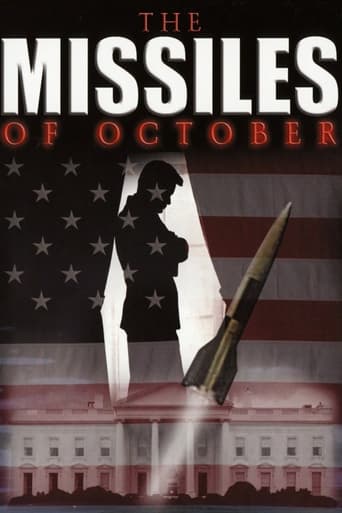
The Missiles of October (1974)
The most powerful docudrama ever produced on The Cuban Missile Crisis
Based in part on Robert F. Kennedy's book, "Thirteen Days," this film profiles the Kennedy Administration's actions during the Cuban Missile Crisis.
- Date of release
- 1974-12-18
- TMDB
- 7.5 / 10 (15)
- Runtime
- 2h 30m
- Genres
- Drama, TV Movie
- Director
- Anthony Page
Casting
- William Devane — President John F. Kennedy
- Ralph Bellamy — U.N. Ambassador Adlai Stevenson
- Howard Da Silva — Soviet Premier Nikita Khrushchev
- James Hong — U.N. Secretary-General U Thant
- Martin Sheen — Attorney General Robert F. Kennedy
- James T. Callahan — David Powers, Special Assistant to the President
- Peter Canon — Admiral's Aide
- Keene Curtis — John McCone, Director CIA
- Charles Cyphers — Press Photographer
- Clifford David — Theodore Sorensen, Special Counsel
- Francis De Sales — Senator
- John Dehner — Former Secretary of State Dean Acheson
Interesting facts
- Based on: Thirteen Days
The Missiles of October is a 1974 television docudrama about the Cuban Missile Crisis in October 1962. The title evokes the 1962 book The Guns of August by Barbara Tuchman, about the missteps amongst the great powers and the failed chances to give an opponent a graceful way out, which led to World War I.
Production notes
The title of the play was influenced by the 1962 book The Guns of August by Barbara W. Tuchman, which describes various events leading to World War I and had been read by US President John F. Kennedy shortly before the crisis. In the play, Kennedy compares events in the book to the crisis with the Soviet Union.
Staged as a two-and-a-half hour television play, the production eschews physical action and detailed sets and wardrobes in favor of emphasis on dialogue, emotion, and decision-making. The plot depicts how the world came close to the brink of but eventually stepped away from global thermonuclear war and highlights the roles of President Kennedy, US Attorney General Robert F.
The Missiles of October gave the American general public its first look behind the scenes at the inner workings, disagreements, and ultimate consensus of the Kennedy administration to blockade Cuba, rather than invade to dislodge the just-discovered partially completed Soviet nuclear missile emplacements in Cuba.
Vice-President Lyndon B. Johnson, who was a member of EXCOMM and was present at most meetings during the crisis, does not appear in the docudrama.
The play was directed by Anthony Page with writing credits given to Stanley R. Greenberg and Robert Kennedy. The play is noted for Sheen's changing accent throughout the play as well as his several flubbed lines in the first several acts.
Read on Wikipedia · Text from Wikipedia, CC BY-SA 4.0. Data from Wikidata.
Recommended
- Return to Zero 2014 · ★ 6.6
- ...First Do No Harm 1997 · ★ 6.8
- TalhotBlond 2012 · ★ 6.3
- Dolly Parton's Coat of Many Colors 2015 · ★ 6.5
- I Am Elizabeth Smart 2017 · ★ 6.8
- Rebound: The Legend of Earl 'The Goat' Manigault 1996 · ★ 7.1
- Girl in the Box 2016 · ★ 6.7
- Freshman Father 2010 · ★ 6.6
- Iron Jawed Angels 2004 · ★ 6.8
- Twelve Angry Men 1954 · ★ 7.8
- Hello Sister, Goodbye Life 2006 · ★ 6.1
- Heaven 2019 · ★ 6.2