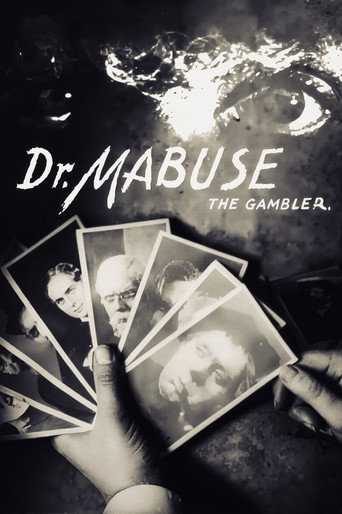
Dr. Mabuse, the Gambler (1922)
Dr. Mabuse, der Spieler
Dr. Mabuse and his organization of criminals are in the process of completing their latest scheme, a theft of information that will allow Mabuse to make huge profits on the stock exchange. Afterwards, Mabuse disguises himself and attends the Folies Bergères show, where Cara Carozza, the main attraction of the show, passes him information on Mabuse's next intended victim, the young millionaire Edgar Hull. Mabuse then uses psychic manipulation to lure Hull into a card game where he loses heavily. When Police Commissioner von Wenk begins an investigation of this mysterious crime spree, he has little to go on, and he needs to find someone who can help him.
- Date of release
- 1922-04-27
- TMDB
- 7.7 / 10 (220)
- Runtime
- 4h 31m
- Genres
- Crime, Thriller
- Director
- Fritz Lang
- Collection
- Dr. Mabuse Collection
Casting
- Rudolf Klein-Rogge — Dr. Mabuse
- Aud Egede-Nissen — Cara Carozza
- Gertrude Welcker — Countess Dusy Told
- Alfred Abel — Count Told
- Bernhard Goetzke — Prosecutor von Wenk
- Paul Richter — Edgar Hull
- Robert Forster-Larrinaga — Spoerri
- Hans Adalbert Schlettow — Georg
- Georg John — Pesch
- Károly Huszár — Hawasch
- Grete Berger — Fine, a servant
- Julius Falkenstein — Karsten
Interesting facts
Dr. Mabuse the Gambler is the first film in the Dr. Mabuse series about the character Doctor Mabuse who featured in the novels of Norbert Jacques. It was directed by Fritz Lang and released in 1922. The film is silent and would be followed by the sound sequels The Testament of Dr. Mabuse (1933) and The Thousand Eyes of Dr. Mabuse (1960).
Production
Production of the first part of Dr. Mabuse the Gambler began while the novel on which it is based, Norbert Jacques's Dr. Mabuse, der Spieler was still being serialized. The film made a number of important changes from the book version. In the book the characters engage in constant soliloquies which would not have adapted well to film, particularly a silent film which would have required many intertitles to make that work.
Lang and von Harbou also added some elements to the film that were not in the novel. One of Mabuse's key skills in the film is as a counterfeiter, but in the novel he never engaged in this. Mabuse's role in counterfeiting money adds to the social subtext and to the themes of the film. The film's opening, a 20-minute tour de force introducing the myth of Mabuse, was also not in the novel.
The film incorporates a number of special effects such as animation and superimpositions. One aspect that was cheered upon the film's original release was the nighttime scene of the automobile chase in which Wenk chases Mabuse, which David Kalat called the most successful execution of such nighttime photography to that time.
It was during the production of this film that Lang and von Harbou began their affair which would ultimately result in their marriage. Although von Harbou was married to Klein-Rogge at the time, their separation was amicable and did not create a problem for the film.
Read on Wikipedia · Text from Wikipedia, CC BY-SA 4.0. Data from Wikidata.
Recommended
- Now You See Me 2 2016 · ★ 6.8
- Family Plot 1976 · ★ 6.8
- F/X 1986 · ★ 6.6
- To Live and Die in L.A. 1985 · ★ 7.1
- T-Men 1947 · ★ 6.7
- The Commuter 2018 · ★ 6.4
- Relay 2025 · ★ 7.0
- Fletch 1985 · ★ 6.7
- The Last Seduction 1994 · ★ 6.7
- Welcome to the Punch 2013 · ★ 5.9
- The Testament of Dr. Mabuse 1933 · ★ 7.6
- Voyeur 2017 · ★ 5.9