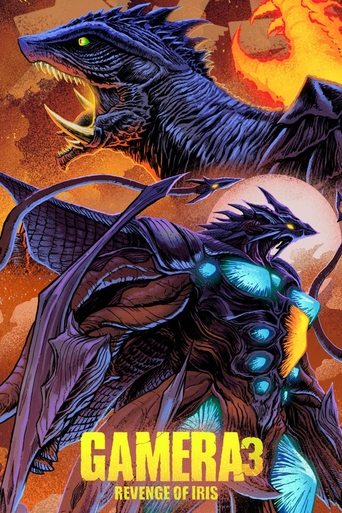
Gamera 3: Revenge of Iris (1999)
ガメラ3 邪神<イリス>覚醒
I will not forgive Gamera.
With the Gyaos re-emerging, Gamera's ties to humanity have been severed with his bond to Asagi broken. Nagamine and Asagi investigate while an orphaned girl named Ayana discovers a new creature she names Iris. Nagamine and Asagi must reach Ayana before she takes her revenge on Gamera, who she blames for the death of her family.
- Date of release
- 1999-03-06
- TMDB
- 7.4 / 10 (136)
- Runtime
- 1h 48m
- Genres
- Fantasy, Science Fiction, Horror
- Director
- Shusuke Kaneko
- Collection
- Gamera (Heisei) Collection
Casting
- Ai Maeda — Ayana Hirasaka
- Shinobu Nakayama — Dr. Mayumi Nagamine
- Aki Maeda — Young Ayana Hirasaka
- Ayako Fujitani — Asagi Kusanagi
- Yû Koyama — Tatsunari Moribe
- Nozomi Ando — Miyuki Moribe
- Ito Takahiro — Satoru Hirasaka
- Senri Yamazaki — Mito Asakura
- Toru Tezuka — Shinya Kurata
- Yukijiro Hotaru — Tsutomu Osako
- Hirotaro Honda — Masaaki Saito
- Kei Horie — Shigeki Hinohara
Interesting facts
Gamera 3: Revenge of Iris is a 1999 Japanese kaiju film directed by Shusuke Kaneko, with special effects by Shinji Higuchi. Produced by Daiei Film and distributed by Toho, the film is the 11th entry in the Gamera film series, as well as the third film in the franchise's Heisei period, serving as a sequel to the 1996 film Gamera 2: Attack of Legion.
Production
Its production was delayed and the film plot was intentionally designed as a horror because of box office results of 1995 and 1996 films, declined popularity of kaiju genre, and contrasting popularity of horror films among children at that time where especially Ring and Ghosts at School and Honto ni atta kowai hanashi franchises had influences on Gamera 3: Revenge of Iris.
Many members of the crew who worked on Gamera 3: Revenge of Iris had previous work in the Gamera film series. Director Shusuke Kaneko directed both Gamera the Guardian of the Universe (1995) and Gamera 2: Attack of Legion (1996). Gamera 3 marks the first Gamera film that Kaneko had screenwriting credits on as he co-wrote the film with Kazunori Ito who had previously written the previous two 1990s Gamera films.
The final draft of the film included several references to previous non-Gamera films by Daiei Film such as the 1962 Daiel film The Whale God (Killer Whale) where a scene for Gamera to encounter a pair of North Pacific right whales was planned.
The plot for Gamera to sacrifice his right arm was inspired by the 1972 film One-Armed Boxer.
Read on Wikipedia · Text from Wikipedia, CC BY-SA 4.0. Data from Wikidata.
Recommended
- Gamera 2: Advent of Legion 1996 · ★ 7.5
- Gamera vs. Gyaos 1967 · ★ 6.1
- Attack on Titan II: End of the World 2015 · ★ 6.3
- The War of the Gargantuas 1966 · ★ 6.3
- Rodan 1956 · ★ 6.5
- Son of Godzilla 1967 · ★ 6.4
- Godzilla vs. Biollante 1989 · ★ 7.3
- Shin Godzilla 2016 · ★ 7.3
- Pacific Rim: Uprising 2018 · ★ 6.1
- Godzilla vs. Megaguirus 2000 · ★ 6.7
- Mothra 1961 · ★ 7.2
- Godzilla Minus One 2023 · ★ 7.6