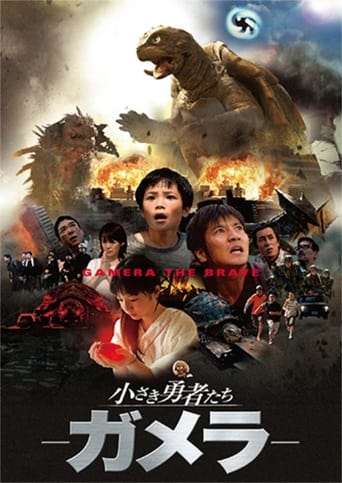
Gamera: A Guardiã do Universo (2006)
小さき勇者たち ~ガメラ~
Tradicional filme de monstros
No estilo do cinema japonês, que resgata uma das mais populares personagens do gênero no País, Gamera, uma espécie de tartaruga capaz de voar e soltar fogo pela boca. Tudo começa quando um garoto que habita uma linda península ao lado de seu pai acha na praia um ovo. Dali nasce essa criatura que cresce mais rápido do que o normal, além de possuir os outros poderes. Ao mesmo tempo, uma série de embarcações começa a desaparecer no local, revelando a existência de um poderoso e terrível monstro chamado Zedus. Ele está pronto para destruir a tudo e todos que moram nas proximidades, até que se vê diante do bichinho de estimação que, na verdade, é a guardiã do universo, Gamera. Agora, a briga está pronta para começar e Gamera terá de se dedicar, se quiser vencer seu oponente que é mais experiente e forte, no princípio.
- Data de estreia
- 2006-04-29
- TMDB
- 7.0 / 10 (86)
- Duração
- 1 h 36 min
- Géneros
- Ação, Aventura, Fantasia, Ficção científica, Família
- Realizador
- 田崎竜太
Elenco
- 富岡涼 — Toru Aizawa
- 夏帆 — Mai Nishio
- 津田寛治 — Kousuke Aizawa
- 寺島進 — Osamu Nishio
- 奥貫薫 — Harumi Nishio
- 小林恵 — Miyuki Aizawa
- Shingo Ishikawa — Ishimaru Ishida
- Shogo Narita — Katsuya Ishida
- 石丸謙二郎 — Professor Soichiro Amamiya
- 田口トモロヲ — Councilor Yoshimitsu Hitotsugi
- 正名僕蔵 — Secretary Yuji Tobata
- Himawari Ono — Girl carrying red stone
Curiosidades
Gamera the Brave is a 2006 Japanese kaiju film directed by Ryuta Tasaki, written by Yukari Tatsui, and produced by Kadokawa Daiei Studio. It is the twelfth and latest installment in the Gamera film series, and serves as the second reboot of the franchise, with the first being Gamera: Guardian of the Universe in 1995, as well as the final installment of the Heisei-era Gamera film series. It is also the first entry in the series to be produced by Kadokawa Daiei Studio after the company purchased a percentage of the remaining assets of Daiei Film, the original studio that was responsible for making the Gamera films.
Production
Despite its popularity, the Heisei Gamera trilogy was highly controversial among executives, crew of the Showa films and even crew of the trilogy itself. Showa Gamera director Noriaki Yuasa, who died two years prior to the release of Gamera the Brave, expressed his frustration with the Heisei trilogy and emphasized the importance of differentiating the franchise from Godzilla, hoping Daiei to "resurrect Showa Gamera", as he describes in 2003's Th…
The Heisei trilogy's direction was shaped due to the tendencies of director Shusuke Kaneko, screenwriter Kazunori Ito and sound designer Shinji Higuchi, who were not fans of both Gamera and Heisei Godzilla continuity, and particularly the first two's motivations for the trilogy being rooted in their frustrations over unrealized opportunities to direct Ultra Q The Movie: Legend of the Stars (1990) and Godzilla vs. Mothra (1992).
Particularly the 1999 film Gamera 3: Revenge of Iris had garnered controversy on release, with reports stating children crying profusely at the destruction Gamera had caused in Shibuya in it, resulting in walk-outs on screenings.
In 2002, Kadokawa acquired Daiei Film from Tokuma Shoten, with Kadokawa president Kazuo Kuroi announcing intentions to produce a Godzilla vs. Gamera film, alongside a reboot of historical tokusatsu series Daimajin. This followed a failed attempt to produce a crossover by Yasuyoshi Tokuma, prior to his death in 2000. Toho eventually turned down the offers, leading to the production of Gamera the Brave.
Daiei executives and crew of Gamera the Brave were aware of the popularity of the Heisei trilogy, Kadokawa Daiei's financial insufficiency, and the risks to fail by rebooting with a completely different series, as taking a different path from the trilogy was controversial (pros and cons were comparable within Kadokawa) where a number of stakeholders had suggested to produce either sequels to the trilogy or its prequel or a side story, or similar…
Ler na Wikipédia · Texto da Wikipédia, CC BY-SA 4.0. Dados do Wikidata.
Recomendados
- Gamera 3: Revenge of Iris 1999 · ★ 7.4
- Rebirth of Mothra 1996 · ★ 6.2
- Gamera 2: Advent of Legion 1996 · ★ 7.5
- Scarygirl - A Miúda Fantástica 2023 · ★ 6.9
- Tartarugas Ninja Heróis Mutantes: O Romper das Sombras 2016 · ★ 6.1
- Gamera vs. Barugon 1966 · ★ 6.4
- O Grande Joe Young 1998 · ★ 6.3
- Gamera vs. Gyaos 1967 · ★ 6.1
- A Lenda de Ochi 2025 · ★ 6.1
- Gamera: The Guardian of the Universe 1995 · ★ 7.4
- Bem-vindo ao Mundo dos Ogglies 2021 · ★ 6.7
- Tartarugas Ninja II: O Segredo da Lama Verde 1991 · ★ 6.2