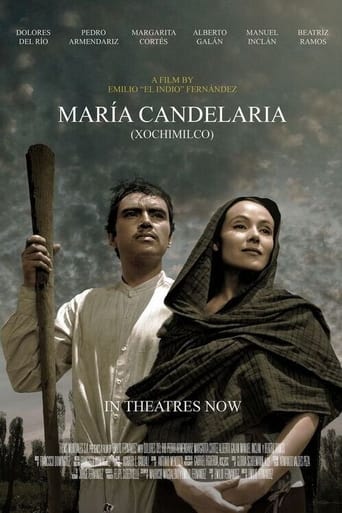
Maria Candelaria (1944)
María Candelaria (Xochimilco)
A young journalist asks an old artist about the portrait of a naked Indian woman that he has in his study. The artist tells the story of Maria Candelaria, a young Indian woman who was rejected by her own people for being the daughter of a prostitute. She is protected by a young Indian man, Lorenzo Rafael, who has fallen in love with her.
- Date of release
- 1944-01-20
- TMDB
- 7.3 / 10 (43)
- Runtime
- 1h 42m
- Genres
- Drama, Romance
- Director
- Emilio Fernández
Casting
- Dolores del Río — María Candelaria
- Pedro Armendáriz — Lorenzo Rafael
- Alberto Galán — El Pintor
- Margarita Cortés — Lupe
- Miguel Inclán — Don Damian
- Beatriz Ramos — Reporter
- Rafael Icardo — Priest
- Julio Ahuet — Jose Alfonso
- Lupe del Castillo — Bone-doctor (as Guadalupe del Castillo)
- Lupe Inclán — Gossip
- Salvador Quiroz — Judge
- Nieves — Model
Interesting facts
María Candelaria is a 1944 Mexican melodrama film written and directed by Emilio Fernández and starring Dolores del Río and Pedro Armendáriz. It was the first Mexican film to be screened at the Cannes International Film Festival where it won the Grand Prix becoming the first Latin American film to do so. María Candelaria would later win a Silver Ariel award for Best Cinematography.
Production
María Candelaria benefited from a time of commercial success in the Mexican film industry in the 1940s and 1950s. Fernández and Figueroa had worked together previously, and they shared a similar vision for the film. In addition to the experienced team of producers, the film benefited from Dolores del Río's success as an actress through the star system.
The film was the gift that Emilio Fernández offered to Dolores del Río, to compensate for his mistreatment of del Río during their filming of Flor silvestre (1943). Emilio's "bronco" temperament had surfaced on several occasions, and the actress had nearly left the film. The pleas of their co-workers, and her high sense of professionalism, convinced del Río to return. However, her relationship with the director had become distant.
"When it was Emilio Fernández's turn to give her his gift, he got close up to Dolores and took a bunch of napkins with writings, and he practically threw them to her and said: This is your birthday present, a history of cinema. I hope you'll like it, it's your next film, it's called Xochimilco. It's yours, it's your property, if somebody wants to buy it, they'll buy it from you."
With the generous gift and all, Dolores had her doubts. She said: "First a rural woman ... And now, an Indian woman, you want me to play an Indian? I ... barefooted?"
The director of photography was Gabriel Figueroa. The art director was Jorge Fernández. The editor was Gloria Schoemann. The music was done by Francisco Domínguez, and the sound was done by Howard Randall, Jesús González Gancy, and Manuel Esperón.
Read on Wikipedia · Text from Wikipedia, CC BY-SA 4.0. Data from Wikidata.
Recommended
- Sunrise: A Song of Two Humans 1927 · ★ 7.8
- The Last Tycoon 1976 · ★ 6.3
- Days of Heaven 1978 · ★ 7.5
- Nobody Has to Know 2022 · ★ 6.7
- Hereafter 2010 · ★ 6.1
- EO 2022 · ★ 6.5
- The Bridges of Madison County 1995 · ★ 7.7
- Dark Waters 2019 · ★ 7.5
- 2 Hearts 2020 · ★ 7.2
- The Secret: Dare to Dream 2020 · ★ 7.4
- Duel in the Sun 1946 · ★ 6.4
- The Longest Ride 2015 · ★ 7.6