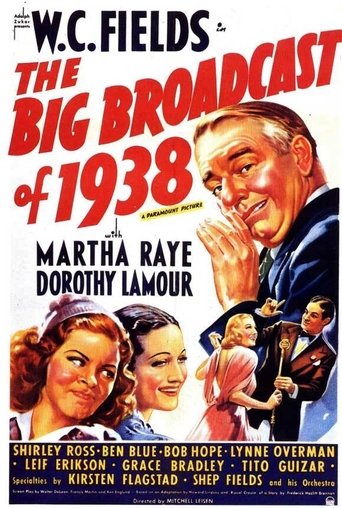
Большое радиовещание в 1938 году (1938)
The Big Broadcast of 1938
Два новейших океанских лайнера соревнуются, кто быстрее пересечет Атлантический океан по рейсу Нью-Йорк — Шербур-Октевиль (Франция). Владелец одного из кораблей Т. Фротингилл (У.К. Филдс) собирается отправить на судно-коункурент своего младшего брата С.Б., который очень похож на него самого. Цель братьев — устроить саботаж на борту корабля и тем самым самим выиграть время, чтобы прибыть в порт первыми. Но С.Б. по ошибке оказывается не на том лайнере... В фильме «Большое радиовещание в 1938 году» впервые прозвучала песня «Thanks for the Memory».
- Дата выхода
- 1938-02-11
- TMDB
- 6.2 / 10 (25)
- Длительность
- 1 ч 34 мин
- Жанры
- комедия, музыка
- Режиссёр
- Mitchell Leisen
- Коллекция
- Big Broadcast Collection
В ролях
- W.C. Fields — T. Frothingill Bellows / S.B. Bellows
- Martha Raye — Martha Bellows
- Дороти Ламур — Dorothy Wyndham
- Shirley Ross — Cleo Fielding
- Lynne Overman — Scoop McPhail
- Bob Hope — Buzz Fielding
- Ben Blue — Mike
- Leif Erickson — Bob Hayes
- Patricia Wilder — Honey Chile
- Grace Bradley — Grace Fielding
- Rufe Davis — Turnkey
- Lionel Pape — Lord Droopy
Интересные факты
The Big Broadcast of 1938 is a Paramount Pictures musical comedy film starring W. C. Fields and featuring Bob Hope. Directed by Mitchell Leisen, the film is the last in a series of Big Broadcast movies that were variety show anthologies. This film featured the debut of Hope's signature song, "Thanks for the Memory" by Ralph Rainger.
Production notes
The screenplay is by Walter DeLeon, Ken Englund, and Francis Martin, based on an adaptation by Howard Lindsay and Russel Crouse, based on a story by Frederick Hazlitt Brennan.
The art direction is by Hans Dreier and Ernst Fegté, with interior decorations by A.E. Freudeman. Costumes were designed by Edith Head. The cartoon sequence integrated with the live action in the "Rippling Rhythm" sequence was produced by Leon Schlesinger.
The film was Hope's first feature film, and was the final film under Fields' long-running Paramount contract, before he moved to Universal Studios to make his final series of films.
While the S.S. Colossal in the film appears to be similar to the 1935 steam turbo-electric-propelled passenger ship S.S. Normandie with its classic Art Deco French Line-styled exterior, the S.S. Gigantic is a Streamline Moderne futuristic-fantasy ship inside and out (based on Norman Bel Geddes "Liner of the Future"), with deck-mounted air propellers and diesel engines powered by remote controlled radio electricity capable of reaching 65 knots, a…
Читать в Википедии · Текст из Википедии, CC BY-SA 4.0. Данные Викиданных.
Рекомендуем
- Большой магазин 1941 · ★ 6.3
- Песня рождена 1948 · ★ 6.5
- Бо Бёрнем: Что. 2013 · ★ 7.8
- Сыграй мою музыку 1946 · ★ 5.8
- Парад в огнях рампы 1933 · ★ 6.9
- Воры и охотники 1930 · ★ 6.9
- Кроссовушка 2022 · ★ 5.9
- Love Happy 1949 · ★ 5.8
- Джон Малэйни & Обед с подростками 2019 · ★ 7.0
- Забавные приключения Дика и Джейн 1977 · ★ 6.6
- День на скачках 1937 · ★ 7.1
- Ратлз: Всё, что тебе нужно – бабки 1978 · ★ 6.8