Sperrmüll (1991)
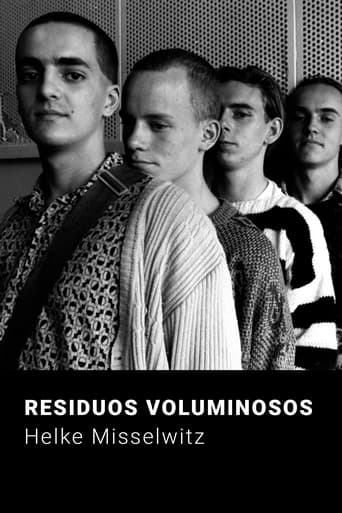
In early summer 1989, Helke Misselwitz portrays young musicians in a band who produce their music on other people’s waste items. The four boys call themselves "Bulk Rubbish" and they drum out their resentment, having grown up on the new housing estates of East Berlin. A straight-up picture of the GDR youth is presented here, which in no way conforms to the official image. The film crew concentrates on the observation of the boy Enrico and his mother Erika: when the mother marries in the West, her son decides to stay in East Berlin, bidding her farewell at the border-crossing. Only shortly after, the tables are turned again: as the events in Berlin leading up to the fall of the Wall are practically captured live from the film crew, Enrico insists on maintaining his cultural identity, even after the fall of the Wall. The "Bulk Rubbish" musicians want to remain citizens of their own state and perceive the looming reunification with scepticism.
- Erscheinungsdatum
- 1991-02-19
- TMDB
- 6.5 / 10 (2)
- Laufzeit
- 1 Std. 19 Min.
- Genres
- Dokumentarfilm
- Regie
- Helke Misselwitz
Besetzung
- Helke Misselwitz — Narrator
Wissenswertes
Sperrmüll ist ein Dokumentarfilm des DEFA-Studios für Dokumentarfilme von Helke Misselwitz aus dem Jahr 1991.
Produktion und Veröffentlichung
Die Dramaturgie lag in den Händen von Gerd Kroske. Die gezeigten Dokumentaraufnahmen stammen aus dem Archiv der Aktuellen Kamera des Deutschen Fernsehfunks.
Als Musikinterpreten wirkten die Gruppe Sperrmüll mit den Mitgliedern Enrico Idzikowski, Tilo Ciesla, Sascha Grohmann und Mirko Becher, sowie die Gruppe Bolschewistische Kurkapelle schwarz-rot.
Sperrmüll wurde von der KAG Kinobox als Farbfilm gedreht und hatte seine Erstaufführung am 11. Mai 1991 im Berliner Kino Babylon
Auf Wikipedia weiterlesen · Text aus Wikipedia, CC BY-SA 4.0. Daten aus Wikidata.
Empfohlen
- 21 Up 1977 · ★ 7.4
- The Class of ‘92 2013 · ★ 7.1
- As I Was Moving Ahead Occasionally I Saw Brief Glimpses of Beauty 2000 · ★ 7.8
- Alexander McQueen – Der Film 2018 · ★ 7.4
- Come See Me in the Good Light 2025 · ★ 7.1
- Fuck 2006 · ★ 6.4
- Meine Mutter Jayne Mansfield 2025 · ★ 7.9
- I Want to Return Return Return 2020 · ★ 6.7
- 42 Up 1999 · ★ 7.6
- A Toxic Love Story 2026 · ★ 6.4
- 28 Up 1985 · ★ 7.5
- 35 Up 1991 · ★ 7.6