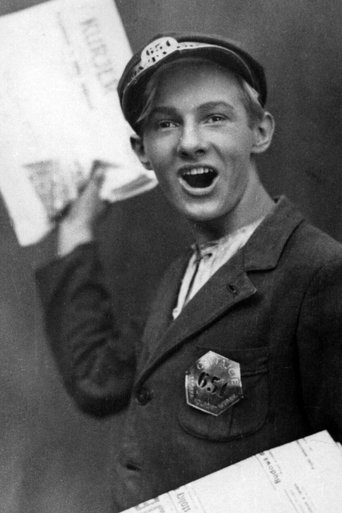
Legion of the Streets (1932)
Legion ulicy
Józek enters a cycling race to win a bike, which he needs to deliver newspapers and pay for his mother's surgery.
- Date of release
- 1932-03-18
- TMDB
- 7.0 / 10 (2)
- Genres
- Drama
- Director
- Aleksander Ford
Casting
- Zofia Mirska — Jaśka
- Stefan Rogulski — Józek
- Tadeusz Fijewski — Władek
- Maria Korska
- Zofia Słowińska
- Hanna Sajówna
- Jerzy Kobusz
- J. Bajl
Interesting facts
Legion ulicy is a Polish black-and-white drama film from 1932 directed by Aleksander Ford, based on a screenplay by Maksymilian Emmer and Andrzej Wolica. The production depicts the story of a teenage boy named Józek. The boy takes a job as a newsboy to help his mother, who has been injured in an accident.
Production
Aleksander Ford became interested in the daily lives of newspaper boys, this "nameless 'the street legion', an atypical product of a big city", during the production of the short film Narodziny i życie gazety (1930). The Leo-Film studio, led by Maria Hirszbein, agreed to produce Legion ulicy due to the project's low costs.
The screenplay for Legion ulicy was written by Maksymilian Emmer and Andrzej Wolica, who collaborated closely with Aleksander Ford on its creation. According to Leszek Armatys, the idea for the film's plot "gravitated towards a sentimental street ballad. Rather optimistic, closer to the simplicity of positivist urban scenes than to the authentic folk culture of street poetry".
Aleksander Ford made several directorial decisions that distinguished Legion ulicy from Polish films produced in the late 1920s and early 1930s. He abandoned the use of studios for authentic street settings and natural interiors, observing life in real time. He limited the casting of professional actors, especially well-known ones, opting instead for non-professional performers.
The film featured the tango Nie igraj z ogniem by Tadeusz Górzyński with lyrics by Stanisław Mara, as well as the tango Raz, dwa, trzy by Szymon Kataszek with lyrics by Jan Brzechwa.
Read on Wikipedia · Text from Wikipedia, CC BY-SA 4.0. Data from Wikidata.
Recommended
- American Flyers 1985 · ★ 6.2
- Gracie 2007 · ★ 6.2
- Hardball 2001 · ★ 6.5
- Cardboard Boxer 2016 · ★ 6.5
- Charm City Kings 2020 · ★ 7.8
- What Maisie Knew 2013 · ★ 7.1
- The Scar 1976 · ★ 6.6
- The Young One 1960 · ★ 7.0
- Run 1991 · ★ 6.0
- Bastard Out of Carolina 1996 · ★ 7.1
- Most 2003 · ★ 7.3
- Johnny 2022 · ★ 7.2