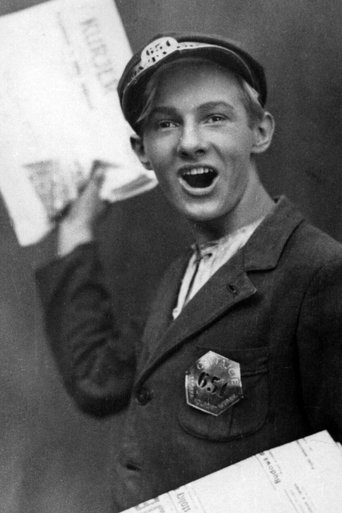
Легион улицы (1932)
Legion ulicy
Мать Юзека, портниха, в результате несчастного случая на несколько месяцев прикована к постели. Чтобы заработать средства к существованию, паренёк по совету друга Владека вступает в "легион улицы", становится продавцом газет. Он знакомится с Яськой, девушкой, которую полюбит. Матери Юзека необходима дорогостоящая операция. Есть только один способ заработать на неё денег - не разносить, а развозить газеты. Но для этого нужен велосипед. Купить его нет возможности. В это время организуется уличная велогонка и главный приз за победу в ней - велосипед...
- Дата выхода
- 1932-03-18
- TMDB
- 7.0 / 10 (2)
- Длительность
- 1 ч 31 мин
- Жанры
- драма
- Режиссёр
- Aleksander Ford
В ролях
- Zofia Mirska — Jaśka
- Stefan Rogulski — Józek
- Тадеуш Фиевский — Władek
- Maria Korska
- Zofia Słowińska
- Hanna Sajówna
- Jerzy Kobusz
- J. Bajl
Интересные факты
Legion ulicy is a Polish black-and-white drama film from 1932 directed by Aleksander Ford, based on a screenplay by Maksymilian Emmer and Andrzej Wolica. The production depicts the story of a teenage boy named Józek. The boy takes a job as a newsboy to help his mother, who has been injured in an accident.
Production
Aleksander Ford became interested in the daily lives of newspaper boys, this "nameless 'the street legion', an atypical product of a big city", during the production of the short film Narodziny i życie gazety (1930). The Leo-Film studio, led by Maria Hirszbein, agreed to produce Legion ulicy due to the project's low costs.
The screenplay for Legion ulicy was written by Maksymilian Emmer and Andrzej Wolica, who collaborated closely with Aleksander Ford on its creation. According to Leszek Armatys, the idea for the film's plot "gravitated towards a sentimental street ballad. Rather optimistic, closer to the simplicity of positivist urban scenes than to the authentic folk culture of street poetry".
Aleksander Ford made several directorial decisions that distinguished Legion ulicy from Polish films produced in the late 1920s and early 1930s. He abandoned the use of studios for authentic street settings and natural interiors, observing life in real time. He limited the casting of professional actors, especially well-known ones, opting instead for non-professional performers.
The film featured the tango Nie igraj z ogniem by Tadeusz Górzyński with lyrics by Stanisław Mara, as well as the tango Raz, dwa, trzy by Szymon Kataszek with lyrics by Jan Brzechwa.
Читать в Википедии · Текст из Википедии, CC BY-SA 4.0. Данные Викиданных.
Рекомендуем
- Американские молнии 1985 · ★ 6.2
- Еретик 2018 · ★ 5.8
- Хардбол 2001 · ★ 6.5
- Война Беннетта 2019 · ★ 6.7
- Грэйси 2007 · ★ 6.2
- Короли Шарм-Сити 2020 · ★ 7.8
- Боксер-марионетка 2016 · ★ 6.5
- Край 2010 · ★ 5.8
- Влияние гамма-лучей на бледно-желтые ноготки 1972 · ★ 7.3
- Джиджи и Нэйт 2022 · ★ 7.6
- Весь день и ночь 2020 · ★ 6.3
- Развод в большом городе 2013 · ★ 7.1