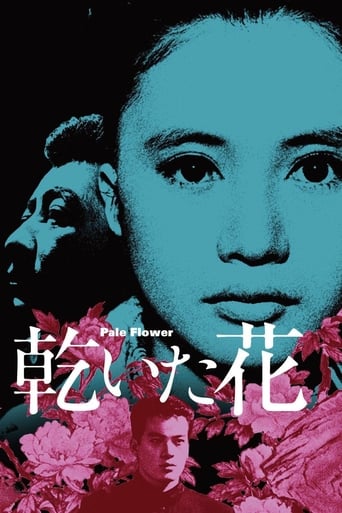
乾いた花 (1964)
A recently released gangster has to cope with the recent shifts of power between gangs, while taking care of a thrill-seeking young woman, who got in bad company while gambling.
Distribuție
- 池部良 — Muraki
- 加賀まりこ — Saeko
- 藤木孝 — Yo
- 杉浦直樹 — Aikawa
- 三上真一郎 — Reiji
- ささきいさお — Jiro
- Koji Nakahara — Tamaki
- 原知佐子 — Shinko Furuta
- 宮口精二 — Funada
- 東野英治郎 — Yasuoka
- Mikizo Hirata — Mizoguchi
- 山茶花究 — Imai
Curiozități
Pale Flower is a 1964 Japanese film noir directed by Masahiro Shinoda. The film is about Muraki, a Yakuza hitman just released from prison. At an illegal gambling parlor, he finds himself drawn to a mysterious young woman named Saeko. Though Saeko loses large sums of money, she asks Muraki to find games with larger and larger stakes. The two become involved in an intense mutually destructive relationship. Film critic Roger Ebert gave Pale Flower four stars and placed it on his list of Great Movies.
Production
Director Shinoda was influenced by Charles Baudelaire's Les Fleurs du mal while making the film. Shinoda chose the subject of yakuza as he felt the yakuza world is the only place where a Japanese ceremonial structure is sustained. The movie was adapted from a novel by Shintaro Ishihara, with Shinoda and Masaru Baba splitting the script for the film (the former doing the first half and the latter doing the second half).
Citește pe Wikipedia · Text din Wikipedia, CC BY-SA 4.0. Date din Wikidata.
Recomandate
- Tokyo Drifter 1966 · ★ 7.1
- Detective Conan: The Time Bombed Skyscraper 1997 · ★ 7.4
- Kiss of Death 1947 · ★ 7.1
- Jaful Perfect 2 2016 · ★ 6.8
- Dreptate la înălțime 2012 · ★ 6.4
- Character 2021 · ★ 7.4
- Fantoma mea iubită 1990 · ★ 7.2
- Batman 1989 · ★ 7.2
- Batman 2022 · ★ 7.7
- He Ran All the Way 1951 · ★ 7.2
- Jaf în stil italian 2003 · ★ 6.8
- Cavalerul negru 2008 · ★ 8.5