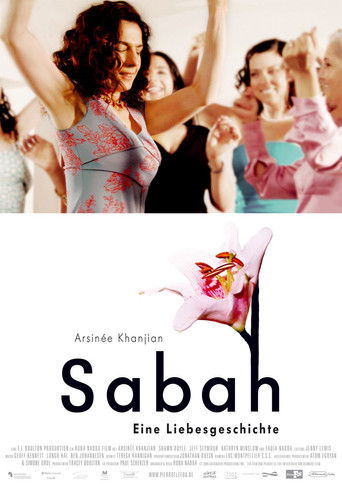
Sabah - Eine Liebesgeschichte (2005)
Sabah
Sabah hat ein Problem. Die kluge und attraktive Muslimin hat sich das erste Mal in ihrem Leben verliebt - Hals über Kopf. Doch ihre Familie würde Stephen niemals akzeptieren, denn er ist zwar groß, gutaussehend und liebenswert, aber definitiv kein Moslem. Obwohl Sabahs Familie seit Jahren in Kanada lebt, ist besonders ihr Bruder, das Familienoberhaupt, sehr konservativ und überwacht jede Minute ihres Leben. Sabahs ganzer Einfallsreichtum und viel Humor ist gefragt, um die immer häufigeren Treffen mit Stephen zu verheimlichen. Aber sie weiß, dass es ist nur eine Frage der Zeit ist, bis ihre Familie die Wahrheit erfährt...
- Erscheinungsdatum
- 2005-06-04
- TMDB
- 5.9 / 10 (15)
- Laufzeit
- 1 Std. 26 Min.
- Genres
- Komödie, Drama, Liebesfilm
- Regie
- Ruba Nadda
Besetzung
- Arsinée Khanjian — Sabah
- Jeff Seymour — Majid
- Kathryn Winslow — Amal
- Shawn Doyle — Stephen Montpellier
- Setta Keshishian — Um Mouhammed
- Roula Said — Shaheera
- Fadia Nadda — Souhaire
- Aaron Abrams — Paramedic
- Mary Lou Fallis — Opera Singer
- David Alpay — Mustafa
- Kaylen Christensen — Girlfriend
Wissenswertes
Sabah is a 2005 film directed by Ruba Nadda and starring Arsinée Khanjian as Sabah, a traditional Muslim woman living in Toronto. She falls in love with Stephen, a non-Muslim Canadian man. The film had the alternate title Coldwater.
Development
Ruba Nadda stated that she got the inspiration to make the film while she was a student at York University; she observed a veiled Muslim woman on a public bus and wondered how she would have dealt with her sexual feelings, and then, how she would have managed affairs if she became infatuated with a non-Muslim man.
Telefilm provided funding for the film, and Nadda enlisted the support of Atom Egoyan and Simone Urdl; the two became the film's executive producers in April 2002 after approving the script. Nadda spent two months in New York City to study film production.
According to Fadia Nadda, in the initial draft Stephen rescues Sabah during their first meeting; Fadia Nadda argued that having them meet in a more mundane manner was more realistic.
Sabah was filmed in Toronto over a three-week period during the summer; a heat wave occurred during the filming. Nadda stated that she wanted to portray Toronto as being a beautiful city, contrasting with a gritty depiction found in other works. Luc Montpellier served as the film's lenser.
Each shot had the colour blue, with red and green also present in smaller amounts; the visuals received inspiration from paintings by Sir Frank Dicksee, Jean-Léon Gérôme, and Edward Hopper. The film uses water as a symbolism for rebirth and charting unknown territory.
Auf Wikipedia weiterlesen · Text aus Wikipedia, CC BY-SA 4.0. Daten aus Wikidata.
Empfohlen
- Love & Sex 2000 · ★ 6.2
- Na typisch! 1991 · ★ 5.9
- Love Don't Cost a Thing 2003 · ★ 7.7
- Numb 2007 · ★ 5.9
- Hitch - Der Date Doktor 2005 · ★ 6.6
- Unersetzlich - Irreplaceable You 2018 · ★ 7.0
- Love in Taipei 2023 · ★ 6.8
- I Can't Think Straight 2008 · ★ 7.5
- Fools Rush In - Herz über Kopf 1997 · ★ 6.5
- Der Vater der Braut 2022 · ★ 6.3
- Love Everlasting 2016 · ★ 7.4
- L.A. Without a Map 1999 · ★ 5.8