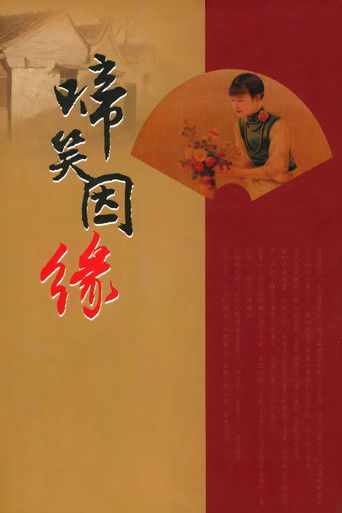
啼笑因缘 (1932)
啼笑因缘
正直青年樊家树(郑小秋 饰)千里迢迢远赴北京求学,某日,他遇见了在天桥上卖艺的街头艺人关寿峰(萧英 饰)以及其女儿秀姑(夏佩珍 饰),一来二去之间,樊家树和关寿峰成为了知心好友。一次偶然中,樊家树结识了名叫沈喜凤(蝴蝶 饰)的女孩,沈喜凤悲惨的身世打动了樊家树,他决定尽自己所能帮助她。随着时间的推移,沈喜凤和樊家树之间渐渐产生了真挚的感情。 当樊家树再次见到关寿峰时,后者已经是一位卧床不起的病人了,樊家树慷慨解囊为关寿峰看病,这让秀姑十分感动,想要以身相遇以报此恩。樊家树的表兄陶伯和(龚稼农 饰)将交际花何丽娜介绍给了樊家树,意图撮合两人,然而早已心有所属的樊家树对美艳的何丽娜十分冷漠。
- 上映日期
- 1932-06-02
- 片长(分钟)
- 1小时9分钟
- 类型
- 剧情
- 导演
- Shichuan Zhang
演员阵容
趣闻
- 拍摄地:北京市
Fate in Tears and Laughter is a 1932 Chinese romantic drama directed by Zhang Shichuan for the Mingxing Film Company. Based on Zhang Henshui's novel of the same name, it follows a young student who falls in love with a singer, even as another woman vies for his attention and a relative attempts to match him with a third. Filmed in Beijing over the course of two months, Fate in Tears and Laughter was subjected to a copyright lawsuit after its première that delayed screening for three months.
Production
Fate in Tears and Laughter was directed by Zhang Shichuan for the Shanghai-based Mingxing Film Company. The screenplay was written by Yan Duhe, while cinematography was by Dong Keyi, Wang Shizhen, and James Williamson. Made with an announced budget of 1.2 million yuan (equivalent to ¥97,000,000 in 2019), production of the film was featured in Mingxing's 1931 film An Amorous History of the Silver Screen.
Mingxing announced its intention to produce Fate in Tears and Laughter on 18 September 1930, issuing a press release that it would be adapting Zhang Henshui's novel of the same name. Serialized in the Xinwen Bao newspaper between 1929 and 1930, the novel Fate in Tears and Laughter had become a reader favourite and quickly adapted to comics, radio, and stage. The company did not, however, register for legal protection of their adaptation rights.
Fate in Tears and Laughter starred Hu Die, Xia Peizhen, Wang Xianzai, Gong Jianong, and Zheng Xiaoqiu. Hu performed dagu, a form of traditional narrative song, for the film.
在维基百科阅读更多 · 文本来自维基百科,CC BY-SA 4.0。数据来自 Wikidata。