The Next Voice You Hear... (1950)
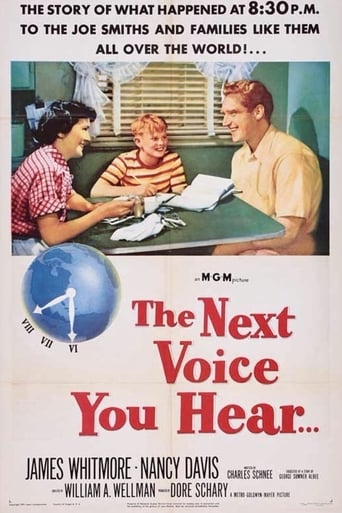
The story of what happened at 8:30 p.m. to the Joe Smiths and families like them all over the world!
The Next Voice You Hear... (1950) is a drama film in which a voice claiming to be that of God preempts all radio programs for days all over the world. It stars James Whitmore and Nancy Davis as Joe and Mary Smith, a typical American couple. It was based on a short story of the same name by George Sumner Albee.
- Date of release
- 1950-06-29
- TMDB
- 5.8 / 10 (8)
- Runtime
- 1h 23m
- Genres
- Drama, Fantasy
- Director
- William A. Wellman
Casting
- James Whitmore — Joe Smith
- Nancy Reagan — Mary Smith
- Gary Gray — Johnny Smith
- Lillian Bronson — Aunt Ethel
- Art Smith — Fred Brannan
- Tom D'Andrea — Harry Magee
- Jeff Corey — Freddie Dibson
- Douglas Kennedy — Mitch (uncredited)
- George Chandler — Motorcycle Officer (uncredited)
- Thomas Browne Henry — Doctor (uncredited)
- Frank Cady — Bald Plant Worker in Locker Room (uncredited)
- Frank Gerstle — Plant Worker in Locker Room (uncredited)
Interesting facts
The Next Voice You Hear... is a 1950 American drama film directed by William Wellman, produced by Dore Schary and starring James Whitmore and Nancy Davis. It is based on a short story of the same name written by George Sumner Albee that had been published in the August 1948 issue of Cosmopolitan magazine.
Production
George Sumner Albee's story "The Next Voice You Hear..." was published in the August 1948 issue of Cosmopolitan magazine. The story differs from the film in several key aspects, as it mainly focuses on the reaction of the general public rather than that of an ordinary American family. The story includes God's exact words, which are not heard in the film.
Producer and MGM production head Dore Schary was drawn to the story for its spiritual tone and acquired the rights to Albee's story, but Schary did not wish to create an epic supernatural film with special effects depicting the miracles described in the story. He wrote a 10,000-word treatment based on the story's general theme but placed the focus on the Smith family and their reaction to the messages.
Schary was also drawn to the project because it challenged traditional film-industry wisdom that religious films and those with underlying messages were poison at the box office. It represented Schary's struggle with studio head Louis B.
Production of the film spanned just 14 days following four days of rehearsals, a greatly condensed schedule in comparison to that of typical features produced by the major studios. The set was closed in order to preserve the secrecy of the film's subject matter.
The film's modest budget of $600,000 was considered an experiment for MGM, where the standard budget for a feature film had exceeded $1,000,000. The budget was the lowest for any MGM feature since World War II and the experiment, directly supervised by Schary, was regarded as an important effort for the studio.
Read on Wikipedia · Text from Wikipedia, CC BY-SA 4.0. Data from Wikidata.
Recommended
- Ken Park 2003 · ★ 6.0
- 90 Minutes in Heaven 2015 · ★ 5.9
- Come Sunday 2018 · ★ 5.8
- Higher Ground 2011 · ★ 5.9
- The Vast of Night 2019 · ★ 6.6
- The Prowler 1951 · ★ 6.8
- Heaven Is for Real 2014 · ★ 6.8
- Nine Days 2021 · ★ 6.8
- The Shepherd 2023 · ★ 7.0
- Five 1951 · ★ 6.6
- Suburbia 1984 · ★ 6.7
- How Sarah Got Her Wings 2015 · ★ 5.9