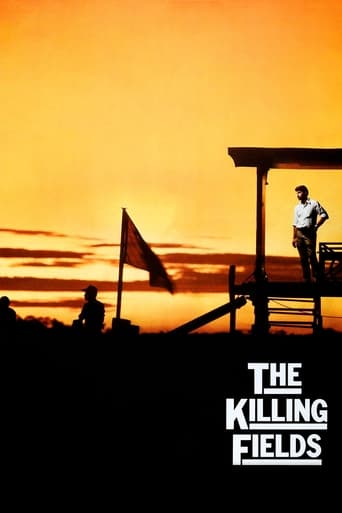
The Killing Fields (1984)
Here, only the silent survive.
New York Times reporter Sydney Schanberg is on assignment covering the Cambodian Civil War, with the help of local interpreter Dith Pran and American photojournalist Al Rockoff. When the U.S. Army pulls out amid escalating violence, Schanberg makes exit arrangements for Pran and his family. Pran, however, tells Schanberg he intends to stay in Cambodia to help cover the unfolding story — a decision he may regret as the Khmer Rouge rebels move in.
- Date of release
- 1984-11-23
- TMDB
- 7.5 / 10 (885)
- Runtime
- 2h 22m
- Genres
- Drama, History, War
- Director
- Roland Joffé
Casting
- Sam Waterston — Sydney Schanberg
- Haing S. Ngor — Dith Pran
- John Malkovich — Al Rockoff
- Julian Sands — Jon Swain
- Craig T. Nelson — Military Attaché
- Spalding Gray — U.S. Consul
- Bill Paterson — Dr. MacEntire
- Athol Fugard — Dr. Sundesval
- Graham Kennedy — Dougal
- Katherine Krapum Chey — Ser Moeum (Pran's Wife)
- Oliver Pierpaoli — Titony (Pran's Son)
- Edward Entero Chey — Sarun
Interesting facts
- Filmed in: New York City, Toronto, Bangkok, and Thailand
- Awards: 5 · Nominations: 7. Including: Silver nugget for the best foreign film; Academy Award for Best Supporting Actor; Academy Award for Best Cinematography; Academy Award for Best Film Editing
The Killing Fields is a 1984 British biographical drama film about the Khmer Rouge regime in Cambodia, which is based on the experiences of two journalists, Cambodian Dith Pran and American Sydney Schanberg. It was directed by Roland Joffé and produced by David Puttnam for Goldcrest Films. Sam Waterston stars as Schanberg, Haing S. Ngor as Pran, and John Malkovich as Al Rockoff. The adaptation for the screen was written by Bruce Robinson; the musical score was written by Mike Oldfield and orchestrated by David Bedford; and the costumes were designed by Judy Moorcroft.
Production
In an interview with The Guardian in November 2014, Joffé said:
David Puttnam asked to see me, which in those days was a bit like being invited out to Hollywood. He gave me Bruce Robinson's script, which was enormous, but it was so full of passion and energy I couldn't put it down. I'd heard about Cambodia and the Khmer Rouge, but didn't know much until I read it.
In the same interview actor Julian Sands said:
Roland's audition process was extraordinary. I was 24 and I've never come across anything as rigorous since. He was looking to put together a troupe of actors without much film experience, because he wanted the freshness of everything to resonate with us. He would gather lots of us in his office to improvise scenes. After about a month, he had a group he found interesting. John Malkovich, Sam Waterston and Haing S.
Puttnam recalled Yoko Ono's reaction to the use of John Lennon's "Imagine" in the film: "“The film ended, and she was in pieces. She climbed over the back of her chair, hugged me and cried. ‘I promise you this,’ she said: ‘This is exactly the way John would have liked the song to have been used.’ It was an amazing moment.”
Read on Wikipedia · Text from Wikipedia, CC BY-SA 4.0. Data from Wikidata.
Recommended
- First They Killed My Father 2017 · ★ 7.3
- Civil War 2024 · ★ 6.8
- Salvador 1986 · ★ 7.0
- Heaven & Earth 1993 · ★ 6.6
- Apocalypse Now 1979 · ★ 8.3
- The Last Full Measure 2020 · ★ 7.3
- Platoon 1986 · ★ 7.7
- Beasts of No Nation 2015 · ★ 7.6
- Full Metal Jacket 1987 · ★ 8.1
- Casualties of War 1989 · ★ 7.2
- The Siege of Jadotville 2016 · ★ 7.1
- We Were Soldiers 2002 · ★ 7.2