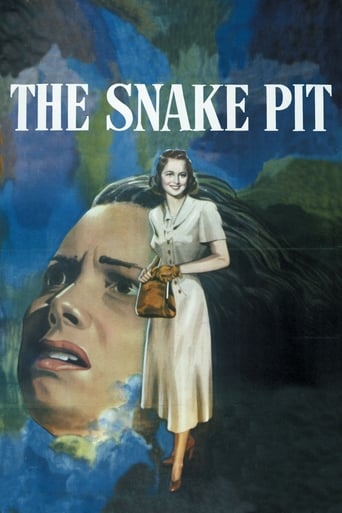
The Snake Pit (1948)
Married and in love... with a man she didn't know or want!
Virginia Cunningham is confused upon finding herself in a mental hospital, with no memory of her arrival at the institution. Tormented by delusions and unable to even recognize her husband, Robert, she is treated by Dr. Mark Kik, who is determined to get to the root of her mental illness. As her treatment progresses, flashbacks depict events in Virginia's life that may have contributed to her instability.
- Date of release
- 1948-11-04
- TMDB
- 7.1 / 10 (118)
- Runtime
- 1h 48m
- Genres
- Drama, Mystery
- Director
- Anatole Litvak
Casting
- Olivia de Havilland — Virginia Cunningham
- Mark Stevens — Robert Cunningham
- Leo Genn — Mark Kik
- Celeste Holm — Grace
- Glenn Langan — Dr. Terry
- Helen Craig — Nurse Davis
- Leif Erickson — Gordon
- Beulah Bondi — Mrs. Greer
- Lee Patrick — Asylum Inmate
- Howard Freeman — Dr. Curtis
- Natalie Schafer — Mrs. Stuart
- Ruth Donnelly — Ruth
Interesting facts
- Awards: 3 · Nominations: 6. Including: Academy Award for Best Sound; National Board of Review: Top Ten Films; Bodil Award for Best American Film
The Snake Pit is a 1948 American psychological drama film directed by Anatole Litvak and starring Olivia de Havilland, Mark Stevens, Leo Genn, Celeste Holm, Beulah Bondi, and Lee Patrick. Based on Mary Jane Ward's 1946 semi-autobiographical novel of the same name, the film recounts the tale of a woman who finds herself in an insane asylum and cannot remember how she got there.
Production
Gene Tierney was the first choice to play the role of Virginia, but was replaced by de Havilland when Tierney became pregnant.
When the book The Snake Pit was still in galleys, the president of Random House, Bennett Cerf, showed it to his friend Anatole Litvak, who bought the rights. Litvak was born in Kiev to Lithuanian Jewish parents and learned filmmaking in Leningrad. He began his career as a director with films in Berlin, Paris, and London. Moving to the United States, Litvak became known as the most prominent director of films with antifascist sentiment.
Director Litvak insisted upon three months of grueling research. He demanded that the entire cast and crew accompany him to various mental institutions and to lectures by leading psychiatrists. He did not have to convince de Havilland, who threw herself into the research with an intensity that surprised even those who knew her well. Her interest derived in part from having had a childhood friend who was hospitalized with schizophrenia.
Litvak was an early adopter and master of the whip pan scene transition device, and used it no fewer than eight times in this film.
Read on Wikipedia · Text from Wikipedia, CC BY-SA 4.0. Data from Wikidata.
Recommended
- Neverwas 2005 · ★ 6.4
- Girl, Interrupted 1999 · ★ 7.6
- Twelve Monkeys 1995 · ★ 7.6
- Shutter Island 2010 · ★ 8.2
- The Saint of Fort Washington 1993 · ★ 6.6
- Stay 2005 · ★ 6.6
- The Blackout 1997 · ★ 5.9
- One Flew Over the Cuckoo's Nest 1975 · ★ 8.4
- Jimmy P. 2013 · ★ 6.1
- Ordinary People 1980 · ★ 7.4
- Mona Lisa and the Blood Moon 2022 · ★ 6.4
- Keane 2004 · ★ 6.0