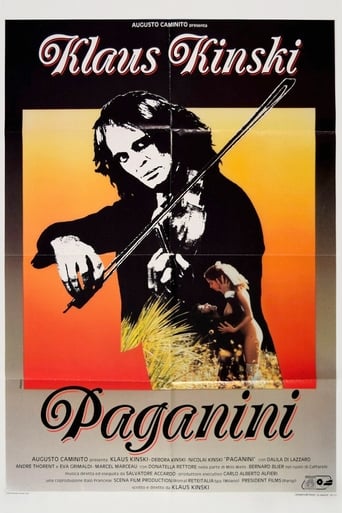
파가니니 (1990)
Paganini
파가니니(Niccolo Paganini : 클라우스 킨스키 분)는 돈과 여자, 그리고 광적인 음악에의 열정으로 살다간 사람이다. 그의 음악에는 유혹과 전율과 엄청난 희열이 분출하고 있다. 당시의 사람들은 그를 가리켜 악마에게 영혼을 판 대가로 바이올린의 천재성을 얻어냈다며 마성에 찬 그의 음악을 시기하면서도 사랑했다. 파가니니의 연주는 쳬중을 광풍 속으로 몰아넣듯이 압도하여 신기에 찬 바이올린 선율로 전율케 한다. 그의 감각적이고 낭만적인 힘에 빨려 든 수 많은 부인과 처녀들 사이에서 끊임없이 물의를 일으키는 파가니니. 교회는 그를 투옥하고, 왕녀들은 선물 공세로 그를 사로잡으려고 한다. 그러나 정작 그가 사랑한 사람은 수많은 여자들이 아니라 오페라 가수 비앙타가 낳은 아들이었다. 거의 동물적이고 맹목적인 부성을 통해 그의 굴절된 삶과 속성이 악마적 음악 세계와 함께 펼쳐진다.
출연진
- 클라우스 킨스키 — Niccolo Paganini
- Debora Caprioglio — Antonia Bianchi (as Debora Kinski)
- Nikolai Kinski — Achille Paganini
- 다릴라 디 라짜로 — Helene von Feuerbach
- Tosca D'Aquino — Angiolina Cavanna
- Bernard Blier — Pater Caffarelli
- Marcel Marceau — Pantomime
- Eva Grimaldi — Marie Anna Elise Bonaparte
- André Thorent — Galvano
- Fabio Carfora — Mr. Watson
- Feodor Chaliapin Jr. — Judge
- Espérance Pham Thai Lan — Gamine (voice)
흥미로운 사실
Kinski Paganini, also known simply as Paganini, is a 1989 biographical film written, directed by and starring Klaus Kinski. Based on the life and career of composer and virtuoso violinist Niccolò Paganini, it was Kinski's only film as director as well as his final acting appearance before his death in 1991.
Production
In his 1999 documentary My Best Fiend, frequent collaborator Werner Herzog explains that Kinski repeatedly asked him to direct the film, but Herzog refused because he thought the script was "unfilmable". Herzog also states that the preparation for his role in Kinski Paganini caused the actor to take on an uncomfortable "alien" air that disrupted Kinski's performance in their last film together, Cobra Verde.
Tosca D'Aquino recalled with shock her experience in the film: "I suffered the harassment of Kinski's very difficult nature. Going back I would not make this film because I suffered a lot. He was a very violent man. I had a complicated relationship, he was bossy, I had bruises." In his autobiography, Kinski, describing one of these scenes with D'Aquino, wrote, "She was embarrassed and closed her legs. I had to block them violently.
위키백과에서 더 읽기 · 텍스트 출처: 위키백과, CC BY-SA 4.0. 데이터 출처: Wikidata.