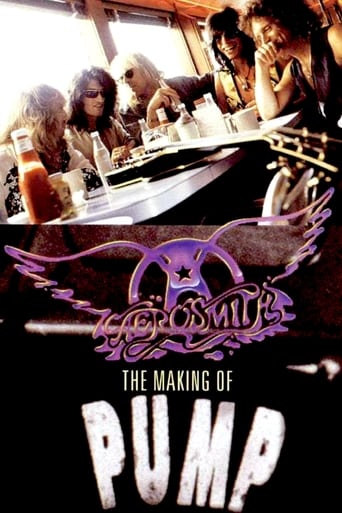
Aerosmith - The Making of Pump (1990)
A behind-the-scenes look at the making of Pump, the album that carried Boston band Aerosmith into the nineties. While this video doesn't include album versions of any of the songs from Pump (Columbia did not have control of the rights), it does include extensive footage of the band members perfecting their craft in the studios, as well as interviews with all those involved.
- Date of release
- 1990-10-09
- TMDB
- 7.8 / 10 (3)
- Runtime
- 1h 50m
- Genres
- Documentary, Music
- Director
- Martin Torgoff
Casting
- Steven Tyler — Himself
- Joe Perry — Himself
- Joey Kramer — Himself
- Brad Whitford — Himself
- Tom Hamilton — Himself
- John Kalodner — Himself
- Bruce Fairbairn — Himself
Interesting facts
Pump is the tenth album by the American rock band Aerosmith. It was released on September 12, 1989, by Geffen Records. The album peaked at No. 5 on the US charts, and was certified 7x Platinum by the RIAA in 1995.
Production
In December 1988, Aerosmith got together at Rik Tinory Productions in Cohasset, Massachusetts to rehearse and compose new songs, as the band members thought the isolated nature of the studio would help their creativity. Over 19 songs were written, split between an "A-list" with songs considered possible hits, such as "Love in an Elevator" and "What It Takes", and the "B-list" having songs yet to be developed such as "Voodoo Medicine Man".
Some songs proposed for the album, though never released in their original form, include "Girl's Got Somethin'", "Is Anybody Out There", "Guilty Kilt", "Rubber Bandit", "Sniffin'", and "Sedona Sunrise". Many songs also had alternate titles, for example, "Voodoo Medicine Man" was originally titled "Buried Alive" and "News for Ya Baby".
In January 1989, the band went to Vancouver to again record at Fairbairn's Little Mountain Sound, where the producer had helmed Bon Jovi's Slippery When Wet and New Jersey. "I don't even listen to Bon Jovi," Steven Tyler protested, "so we didn't say, 'Oh, shit, they had a great album,' and go up there."
Aerosmith were at Little Mountain Sound at the same time that Mötley Crüe were recording their album Dr. Feelgood. As a result, Steven Tyler and the Margarita Horns (Aerosmith's horn section) contributed backing vocals and instrumentation to several tracks on that album. During the vocal sessions, Mick Mars' guitar sound leaked from the room next door due to Mars' volume and many amplifiers.
The intention with the album was exploring a rawness that had been glossed over for a commercial sound in Permanent Vacation. Joe Perry declared that "When we went to do this album, we knew what we wanted, we wanted to strip off a little fat we felt on our last one. We didn't say 'We need a drug song or a child abuse song,' but when they fit, we used them.
Read on Wikipedia · Text from Wikipedia, CC BY-SA 4.0. Data from Wikidata.
Recommended
- Oasis: Don't Look Back in Anger 2026 · ★ 7.0
- Selena Gomez: My Mind & Me 2022 · ★ 8.4
- Justin Bieber's Believe 2013 · ★ 6.9
- Travis Scott: Look Mom I Can Fly 2019 · ★ 6.8
- Iron Maiden: Burning Ambition 2026 · ★ 8.6
- The Beach Boys 2024 · ★ 6.7
- Rolling Thunder Revue: A Bob Dylan Story by Martin Scorsese 2019 · ★ 7.0
- Bad 25 2012 · ★ 7.3
- The Stone Roses: Made of Stone 2013 · ★ 6.9
- God Bless Ozzy Osbourne 2011 · ★ 7.9
- Biggie: I Got a Story to Tell 2021 · ★ 7.1
- Something from Nothing: The Art of Rap 2012 · ★ 6.6