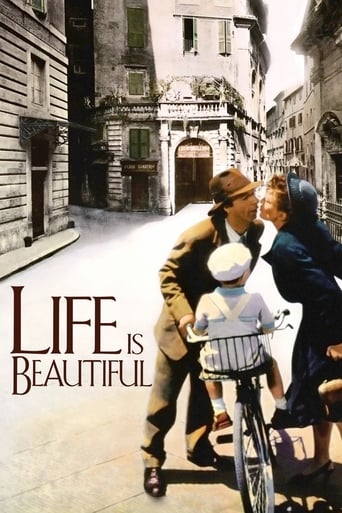
Life Is Beautiful (1997)
La vita è bella
An unforgettable fable that proves love, family and imagination conquer all.
A touching story of an Italian book seller of Jewish ancestry who lives in his own little fairy tale. His creative and happy life would come to an abrupt halt when his entire family is deported to a concentration camp during World War II. While locked up he tries to convince his son that the whole thing is just a game.
- Date of release
- 1997-12-20
- TMDB
- 8.4 / 10 (14443)
- Runtime
- 1h 56m
- Genres
- Comedy, Drama
- Director
- Roberto Benigni
Casting
- Roberto Benigni — Guido
- Nicoletta Braschi — Dora
- Giorgio Cantarini — Giosué
- Giustino Durano — Zio
- Sergio Bini Bustric — Ferruccio
- Marisa Paredes — Dora's Mother
- Horst Buchholz — Doctor Lessing
- Lidia Alfonsi — Mrs. Guicciardini
- Giuliana Lojodice — School Principal
- Amerigo Fontani — Rodolfo
- Pietro De Silva — Bartolomeo
- Francesco Guzzo — Vittorino
Interesting facts
- Box office: $230.1M
- Budget: $19M
- Earned 12.1× its budget
- Filmed in: Rome
- Awards: 8 · Nominations: 11. Including: David di Donatello for Best Film; Cannes Film Festival Grand Prix; César Award for Best Foreign Film; Academy Award for Best Actor
Life Is Beautiful is a 1997 Italian period comedy-drama film directed by and starring Roberto Benigni, who co-wrote the film with Vincenzo Cerami. Benigni plays Guido Orefice, a Jewish Italian man who first works as a waiter while courting a gentile schoolteacher, and later as a bookshop owner who employs his imagination to shield his son from the horrors of internment in a Nazi concentration camp. The film was partially inspired by the book In the End, I Beat Hitler by Rubino Romeo Salmonì and by Benigni's father, who spent two years in the Bergen-Belsen concentration camp during World War II.
Production
Director Roberto Benigni, who wrote the screenplay with Vincenzo Cerami, was inspired by the story of Rubino Romeo Salmonì and his book In the End, I Beat Hitler, which incorporates elements of irony and black comedy. Salmoni was an Italian Jew who was deported to Auschwitz, survived and was reunited with his parents, but found his brothers were murdered.
Benigni's friends advised against making the film, as he is a comedian and not Jewish, and the Holocaust was not of interest to his established audience. Because he is Gentile, Benigni consulted with the Center for Documentation of Contemporary Judaism, based in Milan, throughout production.
The film was shot in the centro storico (historic centre) of Arezzo, Tuscany. The scene where Benigni falls off a bicycle and lands on Nicoletta Braschi was shot in front of Badia delle Sante Flora e Lucilla in Arezzo. The concentration camp was set in an old abandoned factory near Papigno (Terni) that was converted into a concentration camp for filming.
The original score to the film was composed by Nicola Piovani, with the exception of a classical piece which figures prominently: the barcarolle "Belle nuit, ô nuit d'amour" by Jacques Offenbach. The soundtrack album won the Academy Award for Best Original Dramatic Score and was nominated for a Grammy Award for Best Instrumental Composition Written for a Motion Picture, Television or Other Visual Media.
Read on Wikipedia · Text from Wikipedia, CC BY-SA 4.0. Data from Wikidata.
Recommended
- The Zone of Interest 2023 · ★ 7.0
- Jojo Rabbit 2019 · ★ 8.0
- The Truce 1997 · ★ 6.1
- The Devil's Arithmetic 1999 · ★ 6.8
- The Island on Bird Street 1997 · ★ 7.3
- The Last Time We Were Children 2023 · ★ 7.1
- The Children's Train 2024 · ★ 7.4
- White Bird 2023 · ★ 7.8
- The Boy in the Woods 2023 · ★ 7.0
- Ugly, Dirty and Bad 1976 · ★ 7.5
- The Garden of the Finzi-Continis 1970 · ★ 7.0
- Why 1971 · ★ 7.3