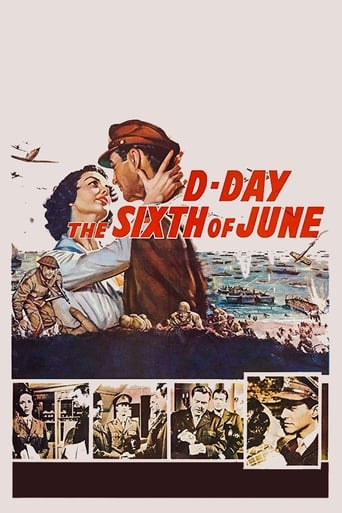
D-Day the Sixth of June (1956)
The Great Love Story of the Great War
En route to Normandy, an American and a British officer reminisce in flashback about their romances with the same woman.
- Date of release
- 1956-05-29
- TMDB
- 5.3 / 10 (31)
- Runtime
- 1h 46m
- Genres
- War, Drama, Romance
- Director
- Henry Koster
Casting
- Robert Taylor — Capt. Brad Parker
- Richard Todd — Lt. Col. John Wynter
- Dana Wynter — Valerie Russell
- Edmond O'Brien — Lt. Col. Alexander Timmer
- John Williams — Brig. Russell
- Jerry Paris — Raymond Boyce
- Robert Gist — Dan Stenick
- Richard Wyler — David Archer
- Alex Finlayson — Col. Harkens
- Ross Elliott — Maj. Mills
- Parley Baer — Sht. Gerbert
- Dabbs Greer — Driver
Interesting facts
- Filmed in: Long Beach Naval Shipyard, Point Dume State Beach, and Century City
D-Day the Sixth of June is a 1956 American DeLuxe Color CinemaScope romance war film made by 20th Century Fox. It was directed by Henry Koster and produced by Charles Brackett from a screenplay by Ivan Moffat and Harry Brown, based on the 1955 novel, The Sixth of June by Lionel Shapiro. The film stars Robert Taylor, Richard Todd, Dana Wynter, and Edmond O'Brien.
Production
Lionel Shapiro (1908–1958) was a Canadian war correspondent for The Montreal Gazette who landed at the Allied invasion of Sicily, Salerno and Juno Beach on D-Day with the Canadian forces. His 1955 romantic novel The Sixth of June was awarded the Governor General's Award for English-language fiction.
Though originally planned to be filmed in Britain with Jean Simmons as the female lead, The Sixth of June (the working title of the film) was made on the Fox backlot with naval scenes filmed at the Long Beach Naval Shipyard, featuring the hospital ship USS Haven (AH-12), whilst the beach landing was made at Point Dume California.
Unlike many American war films D-Day the Sixth of June presents the viewpoints of British characters and features Canadian troops in action. The film's microcosm version of the Normandy landings is a Pointe du Hoc type assault featuring an imaginary "Special Force Six" made up of British, American and Canadian troops in equal quantities.
According to Todd, in the original script his character lived and Taylor's character went back to his wife. However Todd requested that his character be killed.
Edmond O'Brien's character is relieved of command in a similarity to US Army Ranger Major Cleveland A Lytle. Lytle who was to command three companies of the 2nd Ranger Battalion in the assault at Pointe du Hoc heard that Free French sources reported the guns thought to be there had been removed.
Read on Wikipedia · Text from Wikipedia, CC BY-SA 4.0. Data from Wikidata.
Recommended
- Overlord 1975 · ★ 6.8
- Taking Sides 2002 · ★ 6.3
- The History of Love 2016 · ★ 6.5
- Dear John 2010 · ★ 6.8
- Purple Hearts 2022 · ★ 8.0
- The Great Escaper 2023 · ★ 6.7
- Not Easily Broken 2009 · ★ 6.3
- Fixed Bayonets! 1951 · ★ 6.5
- The Longest Day 1962 · ★ 7.6
- Salome 1953 · ★ 5.8
- Private Peaceful 2012 · ★ 6.6
- Racing with the Moon 1984 · ★ 6.3