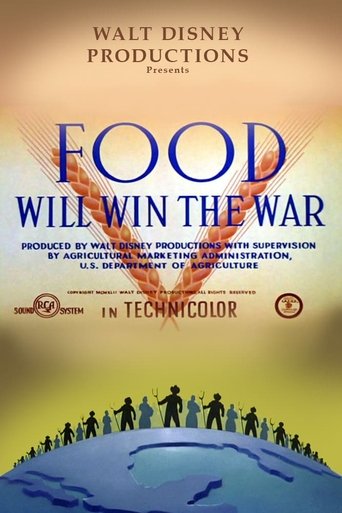
Food Will Win the War (1942)
World War II propaganda film on the importance of American farming. A morale booster film stressing the abudance of American agricultural output.
- Date of release
- 1942-07-20
- TMDB
- 5.7 / 10 (18)
- Runtime
- 6m
- Genres
- Documentary, Animation
- Director
- Hamilton Luske
Casting
- Fred Shields — Narrator
Interesting facts
Food Will Win the War is an American short animated film produced by Walt Disney Studios and released on July 21, 1942, seven months and two weeks after the December 7, 1941 attack on Pearl Harbor. The 6-minute short was one of a series of animated films produced by Disney during the war as part of a propaganda campaign. The animation was produced on order of the Department of Agriculture, first and foremost to educate about the importance of American agriculture in the war effort and also, to offset fears and panic of Americans who thought too many supplies were being sent overseas.
Background
America entered World War 2 on December 8, 1941, after a Japanese attack on Pearl Harbor. Many Americans were reluctant to enter another European war, and preferred a non-interventionist policy towards it, but the devastating and unprovoked attack on Pearl Harbor, which was described by President Franklin D. Roosevelt as a date that will live in infamy, changed public opinion.
Upon America's entrance into the war, Disney was contracted to produce propaganda pieces to gain support for the war and aid recruitment. This was often done through the use of Anti-Nazi propaganda – public opinion polls at the time showed that despite America's anti-war approach, 72% of people preferred the defeat of the Nazis rather than no war and the resulting defeat of the Allies.
America supplied Great Britain and other allies in the war through the Lend-lease 1941, but America would also need to supply its own army. The expectation of America to supply goods abroad through the lend lease agreement, made those on the home front concerned about possible shortages. The fears were unfounded, American agricultural produced a surplus of goods.
In contrast, German agricultural was reliant upon external alliances throughout the war. Britain's blockade of German naval bases seriously restricted Germany from world markets. In the early war years Germany had a surplus amount of grain and raw materials which had been supplied by the USSR, their declaration of war on the USSR in 1941 halted this process. Expectedly, this resulted in substantial grain shortages both at home and abroad.
Conscription in both Germany and the United States by 1942 resulted in a shortage of labor. Both women and children were drafted onto the farms as laborers to help maintain production levels. As Russell Buchanan says: "Women and children being drafted on to farms was one essential factor for agriculture not to drop below the adequate level". Alternatively, by 1939 women made up 37.4% of the total labor force in Germany.
Read on Wikipedia · Text from Wikipedia, CC BY-SA 4.0. Data from Wikidata.
Recommended
- Who Are You, Charlie Brown? 2021 · ★ 6.9
- Why We Fight: Prelude to War 1942 · ★ 6.4
- The Biggest Little Farm 2019 · ★ 7.6
- Audrey 2020 · ★ 7.1
- Kiss the Ground 2020 · ★ 7.7
- Voyage of Time: The IMAX Experience 2016 · ★ 6.9
- Beyond Infinity: Buzz and the Journey to Lightyear 2022 · ★ 7.0
- 180° South 2010 · ★ 7.2
- Being James Bond 2021 · ★ 7.8
- An Inconvenient Truth 2006 · ★ 6.9
- Billie Eilish - Hit Me Hard and Soft: The Tour (Live in 3D) 2026 · ★ 8.4
- WHAM! 2023 · ★ 7.3