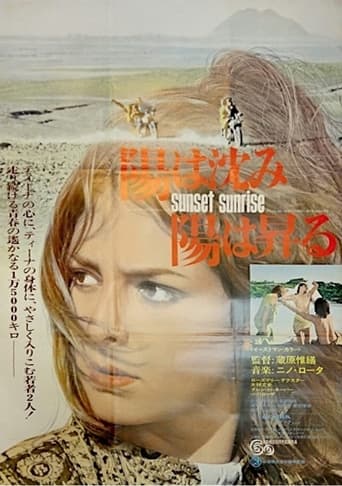
Sunset Sunrise (1973)
陽は沈み陽は昇る
Directed by Koreyoshi Kurahara in 1971, Sunset Sunrise (Hi wa shizumi, hi wa noboru) is a “hippie” road movie chronicling the trek that a handful of people take in order to reach Katmandú, the capital of Nepal.
- Date of release
- 1973-04-29
- TMDB
- 8.1 / 10 (4)
- Runtime
- 2h 21m
- Genres
- Drama, Adventure
- Director
- Koreyoshi Kurahara
Casting
Interesting facts
Sunset, Sunrise is a 1973 Japanese drama film directed by Koreyoshi Kurahara and co-written by Kurahara and Nobuo Yamada. It is a hippie road movie epic, chronicling the trek that a handful of people take to reach Kathmandu, the capital of Nepal. The film was produced as a commemorative work in Nikkatsu's 60th anniversary slate. It is also considered to be part of their Roman Porno line.
Production
Kurahara had started his career at Nikkatsu, making several successful Sun Tribe, crime and drama films for the studio. By 1971, the popularity of television had taken a toll on the Japanese film industry. In order to remain profitable, Nikkatsu turned to the production of Roman Pornos. Many stars and directors left the company over this change in focus.
Keiichi Ozawa and Shōgorō Nishimura. However, after the production of Sunset, Sunrise, he was fired and left Nikkatsu permanently, instead making films for such studios as Toei and Toho.
Sunset, Sunrise was an Italian-Japanese co-production. Shooting took place on-location throughout Europe (including various locations in Italy and Greece, as well as the city of Paris), the West Asian nations of Turkey and Iran, Central Asia (including Afghanistan) and South Asia (including Pakistan and India). Due to the production's scope, it was shot by four cinematographers: Yonezô Maeda, Yoshihiro Yamazaki, Masahiro Tanaka and Koichi Suzuki.
Co-screenwriter Nobuo Yamada collaborated with Kurahara multiple times, earlier on Safari 5000 (1969), and later with Two in the Amsterdam Rain (1975) and Strawberry Road (1991). Editor Akira Suzuki was also a frequent collaborator of the director, having worked with him since the 1957 production of I Am Waiting.
At the time of the film's premiere, the Afghan embassy complained of a rape scene involving Muslim characters. This scene was re-edited prior to the film's theatrical release.
Read on Wikipedia · Text from Wikipedia, CC BY-SA 4.0. Data from Wikidata.
Recommended
- Picnic 1996 · ★ 6.8
- End of Sentence 2019 · ★ 6.2
- Hereafter 2010 · ★ 6.2
- Remember 2015 · ★ 7.3
- True Grit 1969 · ★ 7.3
- Road to Paloma 2014 · ★ 5.8
- Where the Truth Lies 2005 · ★ 6.2
- Scarecrow 1973 · ★ 7.0
- Cave Rescue 2019 · ★ 5.9
- Triage 2009 · ★ 6.0
- Run 1991 · ★ 6.0
- Black Gold 2011 · ★ 6.5