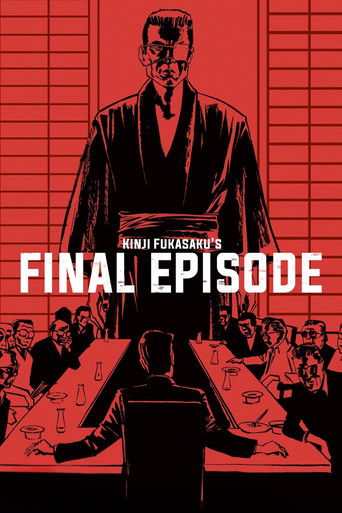
Battles Without Honor and Humanity: Final Episode (1974)
仁義なき戦い 完結篇
While Hirono is in prison, his rival Takeda turns his own crime organization into a political party, whose two executives stir up new tensions in their thirst for power.
- Date of release
- 1974-06-29
- TMDB
- 7.2 / 10 (50)
- Runtime
- 1h 40m
- Genres
- Action, Drama, Crime
- Director
- Kinji Fukasaku
- Collection
- The Yakuza Papers Collection
Casting
- Bunta Sugawara — Shozo Hirono
- Joe Shishido — Katsutoshi Otomo
- Nobuo Yana — Ryôsuke Kaga
- Nobuo Kaneko — Yoshio Yamamori
- Hiroki Matsukata — Ichioka
- Akira Kobayashi — Akira Takeda
- Kunie Tanaka — Masakichi Makihara
- Asao Uchida — Kenichi Okubo
- Shingo Yamashiro — Shozo Eda
- Kenichi Sakuragi — Akio Saeki
- Junkichi Orimoto — Hideo Hayakawa
- Yumiko Nogawa — Kaoru
Interesting facts
Battles Without Honor and Humanity: Final Episode is a 1974 Japanese yakuza film directed by Kinji Fukasaku. It is the final film in a five-part series that Fukasaku made in a span of just two years.
Production
Battles Without Honor and Humanity: Final Episode is the only film in the pentalogy adapting Kōichi Iiboshi's articles about a yakuza war that was not written by Kazuo Kasahara. Instead the screenplay was written by Koji Takada. Kasahara was supportive of Takada, giving him all the research materials he had created for the first four films.
Kasahara suggested not to use the character played by Kinya Kitaoji because it was based on a real yakuza boss that Takada met in Hiroshima (Hisashi Yamada of the Kyosei-kai), but Takada disregarded the advice. The screenwriter said that the real yakuza saw the film and caused problems with the studio.
Like Kasahara, Takada met with Kōzō Minō, the former yakuza whose journals Iiboshi adapted, several times. The screenwriter said that Minō told him he did not like the first four films in the series and proceeded to show him a manuscript for a film he had written himself.
Wanting to change the dynamics of the relationships seen in the previous films, Takada created the characters played by Joe Shishido and Hiroki Matsukata. Finding the yakuza ritual of exchanging sake in the prior films ridiculous, he had the two exchange whiskey instead, which he called one of the best scenes in the series. He made a point to show the general unhappiness of the low-leveled members of the gang.
Ultimately, Takada thinks the script was successful and claimed that Kasahara, director Kinji Fukasaku, and producer Goro Kuasakabe all thought so as well. Although, some critics said the film talks about yakuza who make a living hiding behind legitimate businesses while actually depicting the opposite, and the writer agreed with this critique.
Read on Wikipedia · Text from Wikipedia, CC BY-SA 4.0. Data from Wikidata.
Recommended
- Battles Without Honor and Humanity: Police Tactics 1974 · ★ 7.0
- Battles Without Honor and Humanity 1973 · ★ 7.3
- The Blood of Wolves 2018 · ★ 7.2
- Battles Without Honor and Humanity: Deadly Fight in Hiroshima 1973 · ★ 7.3
- Battles Without Honor and Humanity: Proxy War 1973 · ★ 7.0
- The Yakuza 1974 · ★ 7.1
- Youth of the Beast 1963 · ★ 6.9
- Outrage Coda 2017 · ★ 6.8
- Bad City 2022 · ★ 6.9
- Beyond Outrage 2012 · ★ 7.0
- The Outsider 2018 · ★ 6.1
- Miller's Crossing 1990 · ★ 7.4