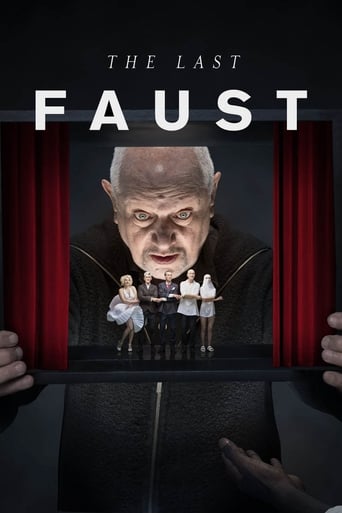
The Last Faust (2019)
Prodigal scientist and technology entrepreneur, Dr Faust, seeks to emulate Gods ability to create life. He sells his soul to the devil in order to realise his greatest ambition - to create the world's first super-human.
- Date of release
- 2019-12-02
- TMDB
- 4.9 / 10 (8)
- Runtime
- 1h 47m
- Genres
- Drama, Horror
- Director
- Dominik Wieschermann, Philipp Humm
Casting
- Steven Berkoff — Dr. Goodfellow
- Martin Hancock — Dr. Faust
- Glyn Dilley — Mephisto
- Yvonne Mai — Gretchen / Witch
- Edwin De La Renta — Homunculus / Paris / Android MUMA17
- Scarlett Mellish Wilson — Helena
Interesting facts
- Based on: Faust and The Last Faust (Gesamtkunstwerk)
- Filmed in: London
The Last Faust is a 2019 feature art film written and directed by the German artist Philipp Humm. Set in 2059, it is a contemporary interpretation of Johann Wolfgang von Goethe's 1808 Faust and the first film directly based on both parts of the tragedy. It stars English actors Steven Berkoff and, Martin Hancock (Faust). Its music is based on Richard Wagner with tracks from Swiss electronic music duo Yello.
Production
The film was part of a bigger project – Humm's Gesamtkunstwerk (also called The Last Faust), a total works of art with over 150 artworks, including an illustrated novella, and a collection of fine-art photos, sculptures, pencil drawings, and paintings. Originally, Humm envisioned to only produce a fine-art photo collection. It then evolved organically to a full-length feature film.
The core script telling the story of Dr. Faust. Humm used the English translation by Martin Greenberg of the original text from Wolfgang von Goethe's Faust, which Humm edited and shortened. The script was structured in 37 chapters or scenes, which Humm felt were the most relevant.
A narrator script, which guides the viewer through the 37 scenes and tells the story of Faust's successor - Dr. Goodfellow. This part was written by Philipp Humm and Ellen Elkin.
The scenes were visualized by Humm into 37 large scale pencil drawings, which later became the storyboard for the film and a foundation for the fine-art photos.
Following the structure of the script, the film was shot in two parts over 20 days with three days of rehearsals.
Read on Wikipedia · Text from Wikipedia, CC BY-SA 4.0. Data from Wikidata.
Recommended
- The Surrender 2025 · ★ 5.9
- The Unhealer 2021 · ★ 5.8
- Nine Days 2021 · ★ 6.8
- A Crooked Somebody 2018 · ★ 6.3
- They Reach 2020 · ★ 6.8
- Chatroom 2010 · ★ 5.8
- Special 2006 · ★ 6.3
- The Most Hated Woman in America 2017 · ★ 6.2
- The Hummingbird Project 2019 · ★ 6.2
- Jonathan 2018 · ★ 5.9
- Azrael 2024 · ★ 5.8
- The Mandela Effect 2019 · ★ 6.3