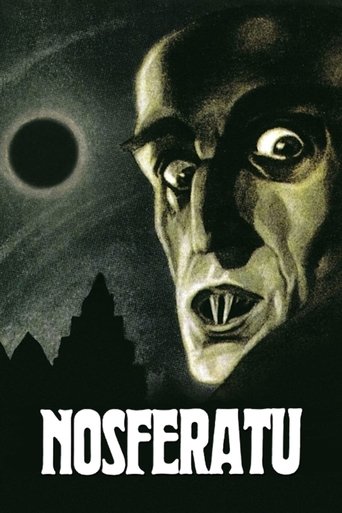
Nosferatu (1922)
Nosferatu, eine Symphonie des Grauens
A symphony of horror.
The mysterious Count Orlok summons a happily married real estate agent to his castle, located up in the Transylvanian mountains, to finalise a terrifying deal.
- Date of release
- 1922-02-16
- TMDB
- 7.6 / 10 (2599)
- Runtime
- 1h 34m
- Genres
- Horror, Fantasy
- Director
- F. W. Murnau
Casting
- Max Schreck — Count Orlok
- Gustav von Wangenheim — Hutter
- Greta Schröder — Ellen
- Georg H. Schnell — Harding
- Ruth Landshoff — Ruth
- Gustav Botz — Professor Sievers
- Alexander Granach — Knock
- John Gottowt — Professor Bulwer
- Max Nemetz — A Ship Captain
- Wolfgang Heinz — Sailor 1
- Albert Venohr — Sailor 2
- Eric van Viele — Sailor (uncredited)
Interesting facts
- Based on: Dracula
- Filmed in: Orava Castle
Nosferatu: A Symphony of Horror is a 1922 silent vampire film directed by F. W. Murnau from a screenplay by Henrik Galeen. It stars Max Schreck as Count Orlok, a vampire who preys on the wife of his estate agent and brings a plague to their town.
Production
The studio behind Nosferatu, Prana Film, was a short-lived silent-era German film studio founded in 1921 by Enrico Dieckmann and occultist artist Albin Grau, named after a Theosophical journal which was itself named for the Hindu concept of prana (life force). Although the studio's intent was to produce occult- and supernatural-themed films, Nosferatu was its only production, as it declared bankruptcy shortly after the film's release.
As a lifelong student of the occult, Grau was able to imbue Nosferatu with hermetic and mystical undertones. One example in particular was the cryptic contract that Count Orlok and Knock exchanged, which was filled in Enochian, hermetic and alchemical symbols. Grau was also a strong influence on Orlok's verminous and emaciated look and he also designed the film's sets, costumes, make-up and the letter with the Enochian symbols.
Diekmann and Grau gave Henrik Galeen, a disciple of Hanns Heinz Ewers, the task to write a screenplay inspired by the Dracula novel, although Prana Film had not obtained the film rights. Galeen was an experienced specialist in dark romanticism; he had already worked on The Student of Prague (1913), and the screenplay for The Golem: How He Came into the World (1920). Galeen set the story in the fictional north German harbour town of Wisborg.
Actor Conrad Veidt was offered the role of Count Orlok, having previously worked with Murnau, but had to decline for scheduling reasons. In the search for an alternative the choice finally fell on the then-still-unknown actor Max Schreck.
Filming began in July 1921, with exterior shots in Wismar. A take from Marienkirche's tower over Wismar marketplace with the Wasserkunst Wismar served as the establishing shot for the Wisborg scene. Other locations were the Wassertor, the Heiligen-Geist-Kirche yard and the harbour.
Read on Wikipedia · Text from Wikipedia, CC BY-SA 4.0. Data from Wikidata.
Recommended
- Van Helsing 2004 · ★ 6.4
- Dracula 1931 · ★ 7.2
- Dracula's Daughter 1936 · ★ 6.0
- Count Dracula 1970 · ★ 5.9
- Dracula Has Risen from the Grave 1968 · ★ 6.7
- The Cellar 2022 · ★ 6.4
- The Black Cat 1934 · ★ 6.7
- Dracula 1958 · ★ 7.2
- Pyewacket 2017 · ★ 5.9
- The Night Walker 1964 · ★ 6.4
- House on Haunted Hill 1959 · ★ 6.7
- Race with the Devil 1975 · ★ 6.4