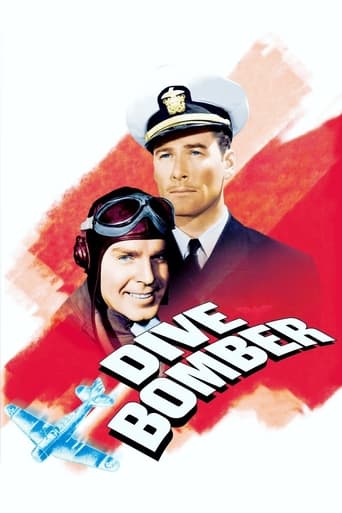
Dive Bomber (1941)
WINGS TO THE WIND...EYES TO THE SKIES!
A military surgeon teams with a ranking navy flyer to develop a high-altitude suit which will protect pilots from blacking out when they go into a steep dive.
- Date of release
- 1941-08-30
- TMDB
- 6.3 / 10 (35)
- Runtime
- 2h 12m
- Genres
- Drama
- Director
- Michael Curtiz
Casting
- Errol Flynn — Douglas S. Lee
- Fred MacMurray — Joe Blake
- Ralph Bellamy — Lance Rogers
- Alexis Smith — Linda Fisher
- Robert Armstrong — Art Lyons
- Regis Toomey — Tim Griffin
- Allen Jenkins — Lucky James
- Craig Stevens — John Thomas Anthony III
- Herbert Anderson — Chubby Markham
- Moroni Olsen — Senior Surgeon at San Diego
- Dennie Moore — Mrs. James
- Louis Jean Heydt — Swede Larson
Interesting facts
- Filmed in: San Diego
- Awards: 0 · Nominations: 1
Dive Bomber is a 1941 American aviation drama film directed by Michael Curtiz, and starring Errol Flynn, Fred MacMurray and Alexis Smith. It was produced and distributed by Warner Bros. Pictures. The film is notable for both its Technicolor photography of pre-World War II United States Navy aircraft and as a historical document of the U.S. in 1941. This includes the aircraft carrier USS Enterprise, one of the best-known U.S. warships of World War II.
Production
Dive Bomber is characterized as "Warner's tribute to the pre-Pearl Harbor U.S. Navy". Based on a screenplay adapted from an original story by Commander Frank "Spig" Wead, USN (Ret), Dive Bomber features spectacular flying scenes (as in other films with a scenario written by Wead) interwoven into a storyline of medical research undertaken to combat the effects of high g-force combat maneuvers.
Upon the first reading of the proposed script, the Department of the Navy realized the potential of the film to be a showcase of U.S. Naval aviation and lent its full support to the production. Dive Bomber's working title was "Beyond the Blue Sky".
In December 1940, Warner Bros. originally intended to star James Cagney, George Brent, and Ronald Reagan, with Lloyd Bacon directing Dive Bomber. By February 1941, however, the script had been revised and the project reconfigured as an Errol Flynn film, with a new director. Filming was given priority over Flynn's other planned vehicle, They Died with Their Boots On (1941) because the U.S. Navy requested Dive Bomber be made as soon as possible.
Fred MacMurray was borrowed from Paramount to star opposite Flynn. In exchange, Paramount borrowed Olivia de Havilland from Warner Bros. for Hold Back the Dawn (1941).
Preproduction planning began in January 1941, and once the generous $1.7 million budget was established, a tight schedule of two months was determined for principal photography on location. Although the U.S. Navy had agreed to cooperate, providing over 1,000 officers and enlisted men along with access to some of its most highly secured facilities, world events had dictated a full war readiness, which placed additional pressures on the film cast a…
Read on Wikipedia · Text from Wikipedia, CC BY-SA 4.0. Data from Wikidata.
Recommended
- Fast Girls 2012 · ★ 6.0
- The High and the Mighty 1954 · ★ 5.9
- Won't Back Down 2012 · ★ 6.2
- One of Our Aircraft Is Missing 1942 · ★ 6.6
- The Wings of Eagles 1957 · ★ 6.3
- The Truth About Emanuel 2013 · ★ 6.0
- Bobby Jones: Stroke of Genius 2004 · ★ 5.9
- No Highway in the Sky 1951 · ★ 7.0
- The River 1984 · ★ 6.4
- Each Dawn I Die 1939 · ★ 6.9
- Eleanor the Great 2025 · ★ 6.8
- Where the Red Fern Grows 1974 · ★ 6.9