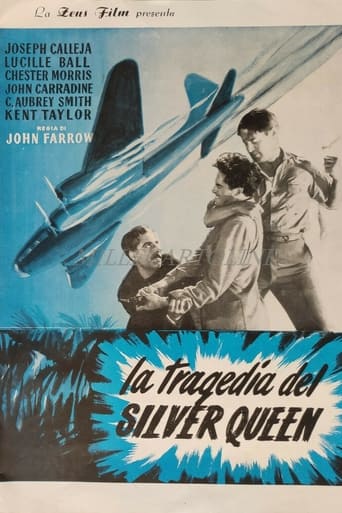
La tragedia del Silver Queen (1939)
Five Came Back
Costretto ad atterrare in una zona della giungla infestata dai cannibali, un aereo offre la possibilità di ripartire solo a poche persone. A sceglierle, pistola alla mano, è uno dei passeggeri che non esita a uccidere un milionario e un'anziana coppia, consegnandosi quindi nelle mani dei selvaggi.
- Data di uscita
- 1939-06-23
- TMDB
- 6.4 / 10 (44)
- Durata
- 1 h 15 min
- Generi
- Avventura, Dramma
- Regista
- John Farrow
Cast
- Chester Morris — Bill Brooks
- Lucille Ball — Peggy Nolan
- Wendy Barrie — Alice Melbourne
- John Carradine — Mr. Crimp
- Allen Jenkins — Pete
- Joseph Calleia — Vasquez
- C. Aubrey Smith — Henry Spengler
- Kent Taylor — Joe
- Patric Knowles — Judson Ellis
- Elisabeth Risdon — Martha Spengler
- Casey Johnson — Tommy Mulvaney
- Dick Hogan — Larry
Curiosità
- Budget: 225K USD
Five Came Back is a 1939 American black-and-white melodrama from RKO Radio Pictures produced by Robert Sisk, directed by John Farrow, written by Jerry Cady, Dalton Trumbo, and Nathanael West, and starring Chester Morris and Lucille Ball. The film was photographed by cinematographer Nicholas Musuraca. Although considered a B movie, the positive notices received by Ball helped launch her career as an A-list actress. Five Came Back is considered a precursor of the disaster film genre. The supporting cast features Wendy Barrie, John Carradine, C. Aubrey Smith, Kent Taylor, and Patric Knowles.
Production
The film was based on an original story by former journalist Richard Carroll. The studio bought it on 12 April 1938 and said it would be a "probable vehicle" for Cary Grant. However, Five Came Back wound up being made as a B picture, albeit a higher budgeted one than normal films of the type. In August 1938 it was announced as part of RKO's schedule for the following year.
Victor McLaglen and Charles Coburn were originally announced as cast members. Eventually, John Carradine was borrowed from 20th Century Fox and Allen Jenkins from Warner Bros. C. Aubrey Smith and Joseph Calleia were also cast. Lucille Ball, Patric Knowles, and Kent Taylor were last-minute replacements for Ann Sothern, Alan Marshall, and Alan Baxter.
Principal photography took place from March 30, to April 26, 1939. The total budget was $225,000.
Although primarily filmed on a back lot, Five Came Back overcame some of the limitations of its low budget. Farrow insisted on a realistic jungle environment, and had trees imported to flesh out the jungle landscape on the sound stage. Ball was reportedly upset by unwanted advances from Morris, and clashed with director Farrow over his harsh tactics.
The transport aircraft used in the film is the Capelis XC-12, built in 1933 by Capelis Safety Airplane Corporation of California, although an altogether different airplane, a Lockheed Electra, is seen in one takeoff sequence. The aircraft was a 12-seat, low-wing cabin monoplane with two 525 hp Wright Cyclone engines.
Leggi su Wikipedia · Testo da Wikipedia, CC BY-SA 4.0. Dati da Wikidata.
Consigliati
- L'urlo dell'odio 1997 · ★ 6.9
- Il volo della fenice 2004 · ★ 6.0
- Prigionieri del cielo 1954 · ★ 5.9
- Alive - Sopravvissuti 1993 · ★ 6.9
- Heart of the Beast - Nel profondo selvaggio 2026 · ★ 7.3
- The Cave - Acqua alla gola 2019 · ★ 5.9
- Cliffhanger - L'ultima sfida 1993 · ★ 6.5
- Gold 2022 · ★ 6.2
- High Ground - Il cacciatore di taglie 2021 · ★ 6.4
- L'isola nel cielo 1953 · ★ 6.2
- La foresta di smeraldo 1985 · ★ 6.6
- Wildwood - I segreti del bosco proibito 2026 · ★ 8.6