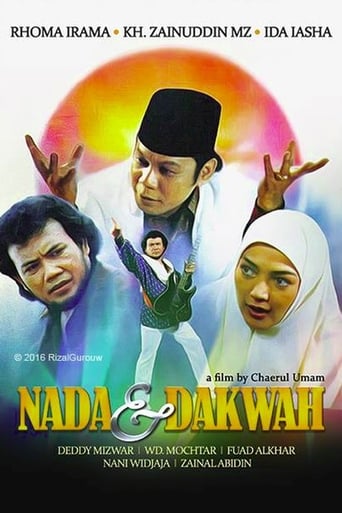
Nada dan Dakwah (1991)
The people of Pandanwangi village are upset at news that their land will be appropriated by a large conglomerate. Conflict over the land emerges and escalates between the villagers and representatives of the conglomerate. The villagers have come to view the situation as more of a matter of morality than of land ownership after finding out that a bar and billiards center will be built there. The head of the village’s Islamic boarding school, H. Murad, who is assisted by H. Rhoma, attempts to influence the villagers to refuse to sell their land. Eventually, the charismatic religious leader KH Zainuddin MZ succeeds in mediating the conflict, and even influences the conglomerate owner, Bustomi (WD. Mochtar), to rethink his plans. The land conflict theme of this film is interesting in that it reflects the social issues arising out of the rapid pace of development of the time. This may be Rhoma Irama’s best film, even though it was not very popular.
- Erscheinungsdatum
- 1991-01-01
- Laufzeit
- 1 Std. 34 Min.
- Genres
- Drama
- Regie
- Chaerul Umam
Besetzung
- Rhoma Irama — Rhoma
- W.D. Mochtar — Bustomi
- Fuad Alkhar
- Nani Widjaja
- Deddy Mizwar
- Ida Iasha
- Zainnuddin M.Z.
- Zainal Abidin
Wissenswertes
- Gedreht in: Indonesien
Nada dan Dakwah is a 1992 Indonesian religious musical drama film directed by Chaerul Umam. Starring Rhoma Irama, Zainuddin M. Z., and Ida Iasha, the film follows a small group of Muslims that successfully challenge a conglomerate's efforts to build a factory on their land. The film, considered one of Rhoma Irama's best, won two awards at the 1992 Indonesian Film Festival. It has been noted for its criticism of the political situation in New Order Indonesia as well as its emphasis on Islamic economics.
Production
Nada dan Dakwah was directed by Chaerul Umam for PT Bola Dunia Film based on an original screenplay by Asrul Sani. Umam, who had a reputation for directing films with Islamic themes, had been collaborating with Sani since Al Kautsar in 1977. Cinematography was handled by Harry Susanto, with artistic direction by Teuku Rusian. Music was handled by Didi AGP, with sound editing by S. Edi Pramono. The film was edited by Effendi Doytha.
Irama was also cast as a protagonist of Nada dan Dakwah. He had previously established a reputation as an actor in musical films with Islamic themes. These had generally featured a love story with an admirer, something absent in Nada dan Dakwah. As co-protagonist, Zainuddin M. Z., a popular preacher whose sermons were widely disseminated through radio, was cast. Both performers played themselves.
Auf Wikipedia weiterlesen · Text aus Wikipedia, CC BY-SA 4.0. Daten aus Wikidata.
Empfohlen
- In my Skin 2018 · ★ 6.2
- Schutzlos - Schatten über Carolina 1996 · ★ 7.1
- Das junge Mädchen 1960 · ★ 7.0
- Hounddog 2008 · ★ 6.5
- Mindwalk 1991 · ★ 6.9
- The Safety of Objects 2002 · ★ 6.5
- Hardball 2001 · ★ 6.5
- Menschen am Fluß 1984 · ★ 6.4
- Skin - Schrei nach Gerechtigkeit 2009 · ★ 6.4
- The Girl in the Book 2015 · ★ 5.8
- Nennt mich verrückt! 2013 · ★ 7.0
- The Short History of the Long Road 2019 · ★ 7.3