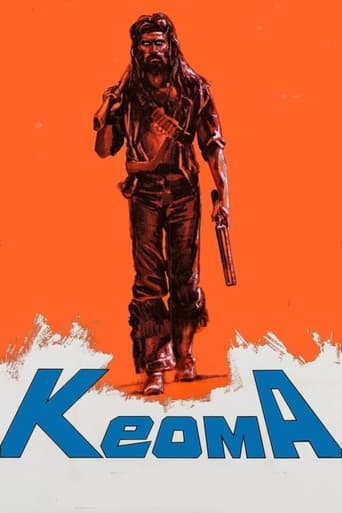
Keoma (1976)
Keoma means freedom
Half-breed Keoma returns to his border hometown after service in the Civil War and finds it under the control of Caldwell, an ex-Confederate raider, and his vicious gang of thugs. To make matters worse, Keoma's three half-brothers have joined forces with Caldwell, and make it painfully clear that his return is an unwelcome one. Determined to break Caldwell and his brothers' grip on the town, Keoma partners with his father's former ranch hand to exact violent revenge.
- Date of release
- 1976-11-25
- TMDB
- 6.8 / 10 (180)
- Runtime
- 1h 42m
- Genres
- Western, Action, Drama
- Director
- Enzo G. Castellari
Casting
- Franco Nero — Keoma
- William Berger — William John Shannon
- Olga Karlatos — Liza Farrow
- Orso Maria Guerrini — Butch Shannon
- Gabriella Giacobbe — The Witch
- Antonio Marsina — Lenny Shannon
- Joshua Sinclair — Sam Shannon
- Donald O'Brien — Caldwell
- Leonardo Scavino — Doctor
- Wolfango Soldati — Wolf
- Victoria Zinny — Saloon Hooker
- Alfio Caltabiano — Clay
Interesting facts
Keoma is a 1976 Italian spaghetti Western film directed by Enzo G. Castellari and starring Franco Nero. It is frequently regarded as one of the better "twilight" spaghetti Westerns, being one of the last films of its genre, and is known for its incorporation of newer cinematic techniques of the time and its vocal soundtrack by Guido & Maurizio De Angelis.
Production
While participating in the filming of 21 Hours at Munich, Franco Nero was approached by his longtime friend and collaborator Enzo G. Castellari and producer Manolo Bolognini on the proposition of appearing in a spaghetti Western, despite dwindling demand for films of that genre.
Keoma was reportedly planned as a sequel to Sergio Corbucci's Django, which Bolognini co-produced. The original treatment was written by actor George Eastman (Luigi Montefiori) and developed into a script by Mino Roli and Nico Ducci, neither of whom was an experienced writer of spaghetti Westerns.
The film was shot over a period of eight weeks, with most principal photography being done at the Elios Studios in Rome, where Corbucci had previously filmed Django. The studio's set was in dire need of repair, which made it easier for Castellari to film as they did not have to redress the sets. The film was also shot on location at Lago di Camposecco.
According to Nero, the music by Guido & Maurizio De Angelis was inspired by Leonard Cohen.
Read on Wikipedia · Text from Wikipedia, CC BY-SA 4.0. Data from Wikidata.
Recommended
- Massacre Time 1966 · ★ 6.4
- Jane Got a Gun 2015 · ★ 5.8
- The Isolate Thief 2026 · ★ 7.1
- A Reason to Live, a Reason to Die 1972 · ★ 6.3
- In a Valley of Violence 2016 · ★ 6.1
- The Revengers 1972 · ★ 5.8
- Gunfight at Rio Bravo 2023 · ★ 6.4
- Kill Them All and Come Back Alone 1968 · ★ 6.3
- Django 1966 · ★ 7.2
- Surrounded 2023 · ★ 6.2
- The Quick and the Dead 1987 · ★ 6.4
- Echoes of War 2015 · ★ 6.0