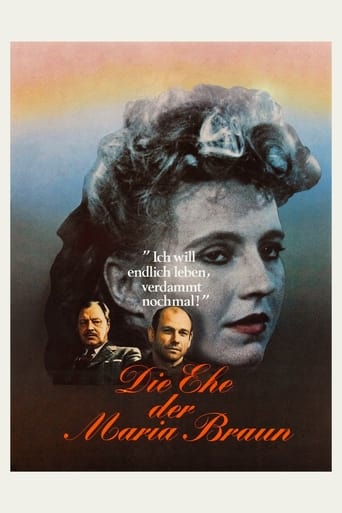
Căsătoria Mariei Braun (1979)
Die Ehe der Maria Braun
Maria marries a young soldier in the last days of World War II, only for him to go missing in the war. She must rely on her beauty and ambition to navigate the difficult post-war years alone.
- Data lansării
- 1979-03-23
- TMDB
- 7.4 / 10 (314)
- Durată
- 2 h 0 min
- Genuri
- Dramă
- Regizor
- Rainer Werner Fassbinder
Distribuție
- Hanna Schygulla — Maria Braun
- Klaus Löwitsch — Hermann Braun
- Ivan Desny — Karl Oswald
- George Eagles — Bill
- Gisela Uhlen — Mother
- Elisabeth Trissenaar — Betti Klenze
- Gottfried John — Willi Klenze
- Hark Bohm — Senkenberg
- Günter Lamprecht — Hans Wetzel
- Lilo Pempeit — Frau Ehmke
- Michael Ballhaus — Counsel
- Rainer Werner Fassbinder — Peddler
Curiozități
- Filmat în: Berlin
The Marriage of Maria Braun is a 1979 West German drama film directed by Rainer Werner Fassbinder. The film stars Hanna Schygulla as Maria, who marries German soldier Hermann Braun during World War II. The couple spend over a decade apart due to forces largely beyond Maria's control. To survive in postwar Germany, Maria becomes a sex worker, a wealthy industrialist's mistress, and eventually a ruthless capitalist during the German economic miracle, while still asserting her loyalty to Hermann.
Production
The idea for The Marriage of Maria Braun can be traced to Fassbinder's collaboration with Alexander Kluge on the unrealized television project The Marriage of our Parents (Die Ehen unserer Eltern), which was developed after the critical success of the omnibus film Germany in Autumn.
The film's producer was Fassbinder's longtime collaborator Michael Fengler and his production company Albatros Filmproduktion. Fengler planned to start shooting the film in the first half of 1978, as Fassbinder's next project Berlin Alexanderplatz was scheduled for June.
From the start, the financing of The Marriage of Maria Braun was precarious. Albatros Filmproduktion contributed only 42,500 DM, the public broadcaster Westdeutscher Rundfunk 566,000, the German Federal Film Board 400,000, and the distributor 150,000. This forced Fengler to find another financing partner. He offered Hanns Eckelkamp's Trio-Film a share in the film in December 1977.
Shooting began in January 1978 in Coburg. Bad-tempered and quarrelsome, Fassbinder shot the film during the day and worked on the Berlin Alexanderplatz script at night. To sustain this schedule he consumed large quantities of cocaine, supplied by the production manager Harry Baer and the actor Peter Berling. According to Berling this was the main reason the film went over budget, as the cash for the cocaine was coming from Fengler.
In February the budget was reaching 1.7 million DM, and the two most expensive scenes, the explosions at the beginning and at end of the film, had not yet been shot. By this time Fassbinder had learned about Fengler's deal with Eckelkamp and the overselling of the film rights. He felt deceived and broke with Fengler.
Citește pe Wikipedia · Text din Wikipedia, CC BY-SA 4.0. Date din Wikidata.
Recomandate
- Zona de interes 2023 · ★ 7.0
- Batalionul 6888 2024 · ★ 7.6
- Ultima ședință a lui Freud 2023 · ★ 6.6
- Hoțul de cărți 2013 · ★ 7.5
- Scăparea către victorie 1981 · ★ 6.9
- Rosenstrasse 2003 · ★ 6.4
- Eroii monumentelor 2014 · ★ 6.1
- The Island on Bird Street 1997 · ★ 7.3
- Voyage of the Damned 1976 · ★ 6.0
- The Last Train 2006 · ★ 7.2
- Uprising 2001 · ★ 6.6
- Bonhoeffer: Pastor. Spion. Asasin. 2024 · ★ 6.7