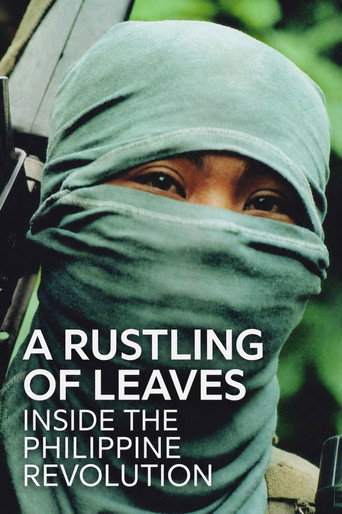
A Rustling of Leaves: Inside the Philippine Revolution (1988)
A chronicle of the three points of a political triangle — the legal left, the illegal (armed) revolution, and the enemy which threatens them both: the armed reactionary right. It is 1987. The dictatorship of Ferdinand Marcos has just been overthrown. Newly elected President Corazon Aquino struggles to wrench control of the country from her own military. A Rustling of Leaves poses the key question facing the revolutionaries and the Filipino Left: Should the People’s Movement continue the guerilla war, or do they dare enter legal politics and reveal the hidden face of the revolution?
- Data de estreia
- 1988-10-13
- TMDB
- 10.0 / 10 (1)
- Duração
- 1 h 52 min
- Géneros
- Documentário
- Realizador
- Nettie Wild
Elenco
- Edicio G. dela Torre — Himself
- Bernabe Buscayno — Himself
- Corazon Aquino — Herself
- Jun Pala
Curiosidades
A Rustling of Leaves: Inside the Philippine Revolution is a 1988 Canadian documentary by Nettie Wild about the political upheaval in the Philippines following the fall of Ferdinand Marcos and the People Power Revolution.
Production
Nettie Wild made a theatre show, Under the Gun-A Disarming Review, about Canada's support for military dictators, including Ferdinand Marcos, in 1983. She received a $8,000 grant from the Canada Council to study the theatre culture of the Philippines and a grant from the National Film Board of Canada to make a film about indigenous Filipino theatre. She went to the Philippines in 1985, and met with the New People's Army.
Wild made two proposals with Chris Pinney, a film distributor in Vancouver. One was a 30-minute film about Filipino street theatre and the other one was a 60-minute film about the NPA. The drafts were sent to the Canadian Broadcasting Corporation, CTV Television Network, PBS, Canada Council, and NFB.
Pinney became a producer on the film, but requested a pseudonym, Chris James, due to its political nature. They planned on starting filming in 1986, but had a difficult time finding financial support. TVOntario was interested, but chose not to finance it while the CBC declined as "Canadians aren't interested in little brown people on the other side of the world" according to Wild.
Wild met with Peter Katadotis, the head of English-language production at the NFB, who supported the project. Pinney was on the committee that chose to hire Katadotis. Katadotis initially obtained a $10,000 grant from the Program to Assist Filmmakers in the Private Sector and later obtained over $260,000 in total for the film. He became the head of production and development at Telefilm Canada during the film's production.
Production started in 1985, with Martin Duckworth as cinematographer and Aerlyn Weissman as the sound recordist. Wild, fearful of being spied on, spoke in code and used other people's phones. Katadotis told her that he was contacted by an official in the Department of Communications who stated that the Canadian Security Intelligence Service wanted every file involving Wild from the NFB as she was "a threat to national security".
Ler na Wikipédia · Texto da Wikipédia, CC BY-SA 4.0. Dados do Wikidata.
Recomendados
- To Be Takei 2014 · ★ 7.2
- Love, Marilyn 2013 · ★ 6.5
- Coração de Cachorro 2015 · ★ 6.5
- In the Realms of the Unreal 2004 · ★ 7.2
- Feminists: What Were They Thinking? 2018 · ★ 7.5
- Love, Gilda 2018 · ★ 7.2
- Democracia em Vertigem 2019 · ★ 7.6
- Harry Dean Stanton: Partly Fiction 2013 · ★ 6.9
- Beyoncé: Life Is But a Dream 2013 · ★ 7.7
- As I Was Moving Ahead Occasionally I Saw Brief Glimpses of Beauty 2000 · ★ 7.8
- My Mom Jayne 2025 · ★ 8.0
- Deliver Us from Evil 2006 · ★ 7.2