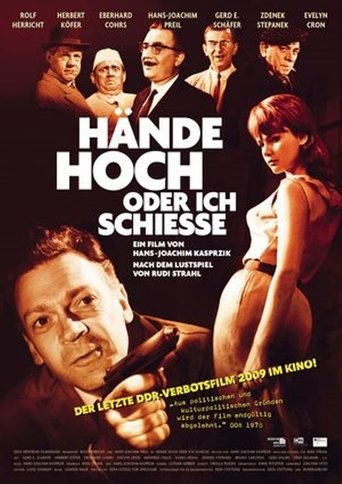
Hände hoch oder ich schieße (1966)
Small town policeman Holms suffers from a rather unusual problem: Because of the low crime rate, there is simply not enough to do for him. Deadly bored, he sinks into the depths of depression and requests the help of a psychiatrist. But his imagination is far more effective: In his dreams, he chases gangsters in London. Finally, some small-time crooks find a way to help "their" policeman out of his emotional misery: They steal a memorial from the market square and thus help Holms to a spectacular case.
- Data di uscita
- 1966-02-01
- TMDB
- 6.8 / 10 (3)
- Durata
- 1 h 16 min
- Generi
- Commedia
- Regista
- Hans-Joachim Kasprzik
Cast
- Rolf Herricht — Holms
- Zdeněk Štěpánek — Pinkas
- Evelyn Cron — Lucie
- Herbert Köfer — Heuschnupf das Aas
- Agnes Kraus — Frau Schulze
- Eberhard Cohrs — Fleischer
- Fred Delmare — Gauner
- Hans Joachim Preil
- Gerd E. Schäfer
- Manfred Uhlig
- Hans Klering
- Bruno Carstens
Curiosità
Hands Up or I'll Shoot is an East German crime comedy film directed by Hans-Joachim Kasprzik, who wrote the script along with Rudi Strahl. Rolf Herricht starred as officer Holms.
Production
On 8 January 1965, screenwriter Rudi Strahl submitted a treatment under the working title The Luckiest Man ('Der glücklichste Mensch') to the DEFA studio. The comedy presented a police officer who is virtually out of work, whose name was Holms — a reference to Sherlock Holmes.
On 5 March, Hans-Joachim Kasprzik — who was regularly employed by the Deutscher Fernsehfunk television channel — agreed to direct the future film. On 19 May, the project was approved by dramaturge Werner Beck, who wrote in his assessment: "the aim of the film is to convey to the viewer, in a very optimistic and entertaining manner, one of the advantages of our socialist order: in a socialist society, the rug is pulled out from under the criminal…
Strahl was instructed to complete the scenario by the end of May. On 26 June, DEFA approved the script's draft. On 15 July, a request to authorize it for production was sent to the studio's director-general Jochen Mückenberger. It was now called Hands Up or I'll Shoot, and was registered as project no. 454.
While Herricht was immediately given the role of Holms, the producers considered offering that of Pinkas to Erwin Geschonneck, Jan Werich, Jaroslav Marvan and even to West German Arno Paulsen, but eventually gave it to Zdeněk Štěpánek on the director's recommendation. On 2 August, the studio approved the final screenplay.
Principal photography commenced on 11 September; it was conducted in Altenburg until the 29th, then in Naumburg. The producers returned to Altenburg for a short session between 4 and 7 October, and afterwards moved to Leipzig, which they left on 12 November. Further filming was made in DEFA's own studios. Photography was completed on 7 January 1966, after seventy-one days: thirty-one in the studio and forty outside.
Leggi su Wikipedia · Testo da Wikipedia, CC BY-SA 4.0. Dati da Wikidata.
Consigliati
- Spenser Confidential 2020 · ★ 6.5
- Perseguitato dalla fortuna 1991 · ★ 6.9
- Trouble Man 2025 · ★ 6.8
- Cold Feet 2018 · ★ 6.6
- La Pantera Rosa sfida l'ispettore Clouseau 1976 · ★ 6.9
- Kokowääh 2 2013 · ★ 6.0
- Pupe calde e mafia nera 1970 · ★ 6.2
- Mr. Bones 2001 · ★ 6.0
- LaRoy, Texas 2024 · ★ 6.8
- Un poliziotto ancora in prova 2016 · ★ 6.3
- Come distruggere il tuo capo 2013 · ★ 6.1
- Driver's Ed - Guida contromano 2026 · ★ 6.9