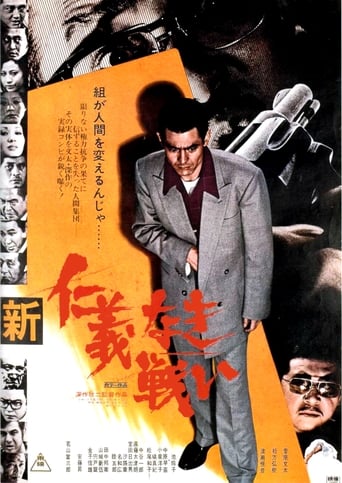
新仁義なき戦い (1974)
Bunta Sugawara is Miyoshi, a low-level assassin of the Yamamori gang who is sent to jail after a bungled hit. While in stir, family member Aoki attempts to seize power from the boss, and Miyoshi finds himself stuck between the two factions with no honorable way out.
- Data di uscita
- 1974-12-28
- TMDB
- 5.9 / 10 (21)
- Durata
- 1 h 38 min
- Generi
- Dramma, Crime, Azione
- Regista
- Kinji Fukasaku
- Collezione
- New Battles Without Honor and Humanity Collection
Cast
- Bunta Sugawara — Makio Miyoshi
- 松方弘樹 — Masaru Seki
- 金子信雄 — Yoshio Yamamori
- 若山富三郎 — Naotake Aoki
- Tsunehiko Watase — Noboru Kitami
- 田中邦衛 — Gen Sakagami
- 池玲子 — Keiko
- 小泉洋子 — Yumi
- 守田学哉 — Amano
- 室田日出男 — Masuo Nozaki
- 中谷一郎 — Shigeru Nanba
- 汐路章 — Gambler
Curiosità
New Battles Without Honor and Humanity is a 1974 Japanese yakuza film directed by Kinji Fukasaku. It begins a new series of films with unrelated plots, based on the director's earlier Battles Without Honor and Humanity pentalogy. New Battles Without Honor and Humanity: The Boss's Head followed in 1975 and New Battles Without Honor and Humanity: Last Days of the Boss in 1976.
Production
Following the success of the original five-part Battles Without Honor and Humanity series, Toei asked director Kinji Fukasaku to create another installment and he quickly agreed. Fukasaku biographer and film expert Sadao Yamane believes the director did not agree chiefly for the money, but because he was glad audiences liked them. New Battles Without Honor and Humanity features many of the same performers from the previous series in new roles.
Yamane feels that New Battles Without Honor and Humanity clearly uses the previous five films as a template, with lead actor Bunta Sugawara playing "more or less the same character", although he called Makio Miyoshi more of a "reckless punk" without "much depth." He also stated that Tomisaburo Wakayama's character is the same role that Hiroki Matsukata played in the original 1973 film.
Dialogue spoken by Wakayama's character about Reiko Ike's character in a scene approximately 53 minutes into the film is censored in the original 35 mm negative and all digital copies. Toei said that the brief audio included discriminatory language about Koreans which was "frowned upon at the time," and censored prior to the film's original theatrical release in 1974.
Leggi su Wikipedia · Testo da Wikipedia, CC BY-SA 4.0. Dati da Wikidata.
Consigliati
- Lotta senza codice d'onore 1973 · ★ 7.3
- Outrage 2010 · ★ 6.9
- Battles Without Honor and Humanity - Deadly Fight in Hiroshima 1973 · ★ 7.3
- Outrage Coda 2017 · ★ 6.8
- Outrage Beyond 2012 · ★ 7.0
- I 2 che spezzarono il racket 1974 · ★ 6.6
- La farfalla sul mirino 1967 · ★ 7.2
- Yakuza 1974 · ★ 7.1
- Lady Snowblood 1973 · ★ 7.5
- Crying Freeman 1995 · ★ 6.4
- Brother 2000 · ★ 7.1
- Dead or Alive 1999 · ★ 6.4