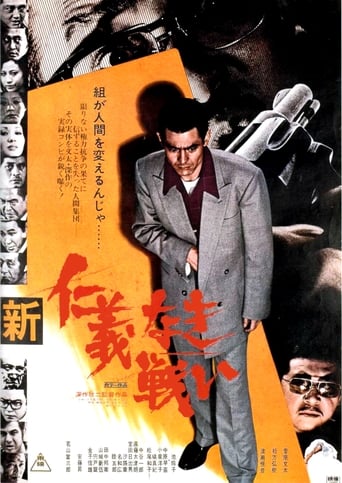
新无仁义之战 (1974)
新仁義なき戦い
昭和25年,山守组小头目三好万龟夫(菅原文太 饰)路袭敌对帮派头目,被判11年徒刑。服刑期间,随着日本经济的复苏和韩战的爆发,山守组不断壮大,而组织内部也分为山守、青木和难波三派。为壮大实力,三派先后拉拢三好,表面和谐之下暗流涌动。 三好假释的数日后,难波(中谷一郎 饰)被杀,幕后操纵者青木(若山富三郎 饰)转而求助广岛最大的组织海津组。以海津组为后盾,并联合难波组第二代头领野崎(室田日出男 饰),最终逼迫山守组组长(金子信雄 饰)退位。登上顶峰的青木成为众矢之的,险被暗杀开始图谋反击的三好、被迫退位阴谋复辟的山守以及誓为组长报仇的难波组第二代关胜(松方弘树 饰)等人全都伺机而动。一场搅和了阴谋与仁义的黑帮战争即将爆发…
- 上映日期
- 1974-12-28
- TMDB
- 5.9 / 10 (21)
- 片长(分钟)
- 1小时38分钟
- 类型
- 剧情, 犯罪, 动作
- 导演
- 深作欣二
- 系列
- 新无仁义之战(系列)
演员阵容
- 菅原文太 — Makio Miyoshi
- 松方弘树 — Masaru Seki
- 金子信雄 — Yoshio Yamamori
- 若山富三郎 — Naotake Aoki
- 渡濑恒彦 — Noboru Kitami
- 田中邦卫 — Gen Sakagami
- 池玲子 — Keiko
- 小泉洋子 — Yumi
- 守田学哉 — Amano
- 室田日出男 — Masuo Nozaki
- 中谷一郎 — Shigeru Nanba
- 汐路章 — Gambler
趣闻
New Battles Without Honor and Humanity is a 1974 Japanese yakuza film directed by Kinji Fukasaku. It begins a new series of films with unrelated plots, based on the director's earlier Battles Without Honor and Humanity pentalogy. New Battles Without Honor and Humanity: The Boss's Head followed in 1975 and New Battles Without Honor and Humanity: Last Days of the Boss in 1976.
Production
Following the success of the original five-part Battles Without Honor and Humanity series, Toei asked director Kinji Fukasaku to create another installment and he quickly agreed. Fukasaku biographer and film expert Sadao Yamane believes the director did not agree chiefly for the money, but because he was glad audiences liked them. New Battles Without Honor and Humanity features many of the same performers from the previous series in new roles.
Yamane feels that New Battles Without Honor and Humanity clearly uses the previous five films as a template, with lead actor Bunta Sugawara playing "more or less the same character", although he called Makio Miyoshi more of a "reckless punk" without "much depth." He also stated that Tomisaburo Wakayama's character is the same role that Hiroki Matsukata played in the original 1973 film.
Dialogue spoken by Wakayama's character about Reiko Ike's character in a scene approximately 53 minutes into the film is censored in the original 35 mm negative and all digital copies. Toei said that the brief audio included discriminatory language about Koreans which was "frowned upon at the time," and censored prior to the film's original theatrical release in 1974.
在维基百科阅读更多 · 文本来自维基百科,CC BY-SA 4.0。数据来自 Wikidata。