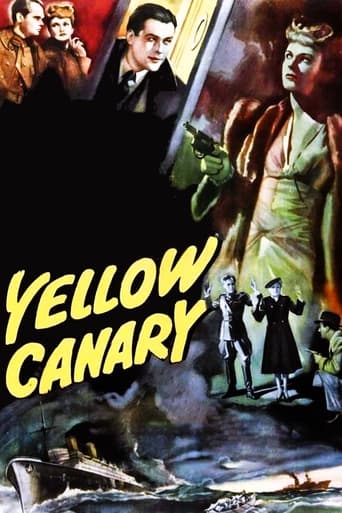
Yellow Canary (1943)
Im Jahr 1940 sieht sich Sally Maitland gezwungen, England zu verlassen, nachdem sie – selbst von ihrer wohlhabenden Familie – als Nazi-Sympathisantin geächtet wurde. Auf der Überfahrt nach Halifax (Kanada) wird sie sowohl von dem polnischen Aristokraten Jan Orloch als auch von dem unbeholfenen britischen Marine-Geheimdienstoffizier Jimmy Garrick umworben.
- Erscheinungsdatum
- 1943-12-13
- TMDB
- 5.4 / 10 (15)
- Laufzeit
- 1 Std. 34 Min.
- Genres
- Drama, Thriller, Kriegsfilm
- Regie
- Herbert Wilcox
Besetzung
- Anna Neagle — Sally Maitland
- Richard Greene — Lieutenant Commander Jim Garrick
- Nova Pilbeam — Betty Maitland
- Albert Lieven — Jan Orlock
- Lucie Mannheim — Madame Orlock
- George Thorpe — Colonel Charles Hargraves
- Marjorie Fielding — Lady Maitland
- Franklin Dyall — Captain Foster
- Margaret Rutherford — Mrs. Towcester
- Claude Bailey — Major Fothergill
- Valentine Dyall — German Commander
- Sybille Binder — Madame Orlock's Attendant
Wissenswertes
Yellow Canary is a 1943 British drama film directed by Herbert Wilcox and starring Anna Neagle, Richard Greene and Albert Lieven. Neagle plays a British Nazi sympathiser who travels to Halifax, Canada, trailed by spies from both sides during the Second World War. Neagle and director/producer Wilcox collaborated on a number of previous film projects.
Production
Although never identified as Unity Mitford, the central character played by Neagle has some obvious similarities to the pro-Nazi British dilettante who had a great deal of notoriety in pre-war times. In production during 1943, while the United Kingdom was still fearful of Nazi spies, Yellow Canary was obviously made as wartime propaganda, with the aim to keep up morale and also warn the British public to be on their guard.
Co-stars Richard Greene and Margaret Rutherford both went on to further success and Rutherford was especially adept at scene-stealing in Yellow Canary. Greene was in the armed forces at this time and had interrupted his successful acting career to serve in the Second World War in the 27th Lancers, where he distinguished himself. After three months, he went to Sandhurst and was commissioned.
Although set aboard a ship in the early scenes, the majority of the principal photography for Yellow Canary took place at the massive lots at Denham Film Studios (D&P Studios), located near the village of Denham, Buckinghamshire. All of the location sequences of Halifax were strictly "B" roll, but did provide a realistic, "atmospheric" look at wartime conditions in the busy Canadian military and civilian port.
After production had wrapped, Neagle and Wilcox made their professional relationship a personal one as well when they married on 9 August 1943.
Auf Wikipedia weiterlesen · Text aus Wikipedia, CC BY-SA 4.0. Daten aus Wikidata.
Empfohlen
- Kesselschlacht 1949 · ★ 6.7
- Nur ein einziges Leben 2020 · ★ 6.3
- Der Seefuchs 1955 · ★ 6.3
- Die letzte Fahrt der Bismarck 1960 · ★ 6.9
- 36 Stunden 1964 · ★ 7.1
- Die Kanonen von Navarone 1961 · ★ 7.3
- Zwischenfall im Atlantik 1965 · ★ 7.0
- Das Quiller Memorandum - Gefahr aus dem Dunkel 1966 · ★ 5.9
- Der lange Weg nach Cardiff 1940 · ★ 6.6
- Unternehmen Seeadler 1951 · ★ 6.1
- Die Seewölfe kommen 1980 · ★ 5.9
- Einer kam durch 1957 · ★ 6.8