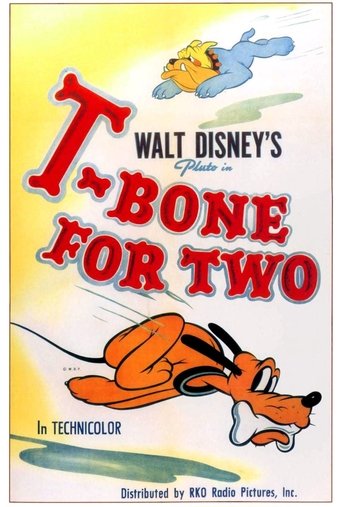
T-Bone for Two (1942)
Pluto finds a bone - but also finds Butch the bulldog, who claims it for himself. Idea: Pluto paces off a distance, buried treasure style, and digs a large bone-shaped hole. Butch falls for it, and while he's digging deeper, Pluto almost makes off with the bone. Butch catches on just in time and chases Pluto, who ducks into a junkyard. The bone gets sucked into in a squeeze-bulb horn, which Pluto does battle with.
- Date of release
- 1942-08-14
- TMDB
- 6.2 / 10 (25)
- Runtime
- 7m
- Genres
- Animation, Family, Comedy
- Director
- Clyde Geronimi
Casting
- Pinto Colvig — Pluto (voice)
Interesting facts
Pluto is a series of American animated comedy short films produced by Walt Disney Productions. The series started in 1937 with Pluto's Quin-puplets and ended in 1951 with Cold Turkey. The series stars the titular character Pluto, introduced in the Mickey Mouse film series as Mickey's pet dog, in addition to having recurring appearances by previously known characters such as Minnie Mouse, Figaro the Kitten, and Mickey Mouse, and also introduced well-known characters such as the chipmunk duo Chip 'n' Dale.
Production
The short films were produced by Walt Disney Productions, and distributed by RKO Radio Pictures (later shorts being distributed by Buena Vista Distribution in re-releases). Like other Disney animated shorts in the golden age of American animation, the shorts begin with a starburst with a close-up of the star character's face (in this case Pluto), followed by the title "A Walt Disney Pluto".
Most of the shorts were directed by Charles Nichols. Another director of a considerable number of shorts in the series was Clyde Geronimi.
Being Pluto a dog and most of supporting characters being also animals without dialogue, the plot of most shorts is understood through their expressions, gestures, and actions. This made Pluto short films pioneering cartoons in animation, counting on characters who express personality through physical actions rather than dialogue.
Read on Wikipedia · Text from Wikipedia, CC BY-SA 4.0. Data from Wikidata.
Recommended
- Ferdinand the Bull 1938 · ★ 6.7
- Beach Picnic 1939 · ★ 6.2
- Spinning 2013 · ★ 6.1
- The Big Bad Wolf 1934 · ★ 6.5
- Thru the Mirror 1936 · ★ 7.2
- Ye Olden Days 1933 · ★ 6.4
- Mickey and the Seal 1948 · ★ 6.8
- Knighty Knight Bugs 1958 · ★ 7.2
- Forky Asks a Question: What Is a Computer? 2019 · ★ 5.9
- Forky Asks a Question: What Is Money? 2019 · ★ 6.0
- Hawaiian Vacation 2011 · ★ 7.0
- Cars Toon Mater's Tall Tales 2008 · ★ 7.1