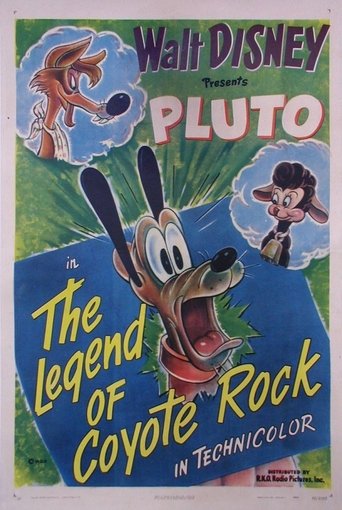
The Legend of Coyote Rock (1945)
Pluto is guarding a flock of sheep in the West; a coyote is sneaking up on that flock. The coyote fakes a bad leg; Pluto chases it away, only to have it run back ahead of him and go after the sheep. Pluto gets back and finds the coyote chasing the lone black sheep of the flock, after trapping the rest. The chase ends with the coyote buried under a toppling spire of rock, which forms a coyote of rock on the top.
- Date of release
- 1945-08-24
- TMDB
- 6.4 / 10 (27)
- Runtime
- 7m
- Genres
- Animation, Comedy
- Director
- Charles August Nichols
Casting
- Pinto Colvig — Pluto (voice)
- Cactus Mack — Narrator
Interesting facts
Pluto is a series of American animated comedy short films produced by Walt Disney Productions. The series started in 1937 with Pluto's Quin-puplets and ended in 1951 with Cold Turkey. The series stars the titular character Pluto, introduced in the Mickey Mouse film series as Mickey's pet dog, in addition to having recurring appearances by previously known characters such as Minnie Mouse, Figaro the Kitten, and Mickey Mouse, and also introduced well-known characters such as the chipmunk duo Chip 'n' Dale.
Production
The short films were produced by Walt Disney Productions, and distributed by RKO Radio Pictures (later shorts being distributed by Buena Vista Distribution in re-releases). Like other Disney animated shorts in the golden age of American animation, the shorts begin with a starburst with a close-up of the star character's face (in this case Pluto), followed by the title "A Walt Disney Pluto".
Most of the shorts were directed by Charles Nichols. Another director of a considerable number of shorts in the series was Clyde Geronimi.
Pluto being a dog and most of the supporting characters also being animals without dialogue, the plot of most shorts is understood through their expressions, gestures, and actions. This made Pluto short films pioneering cartoons in animation, counting on characters who express personality through physical actions rather than dialogue.
Read on Wikipedia · Text from Wikipedia, CC BY-SA 4.0. Data from Wikidata.
Recommended
- Canine Caddy 1941 · ★ 6.5
- Mickey's Delayed Date 1947 · ★ 6.6
- Donald and Pluto 1936 · ★ 6.7
- Casanova Cat 1951 · ★ 6.7
- The Yankee Doodle Mouse 1943 · ★ 7.2
- A Knight for a Day 1946 · ★ 6.6
- How to Play Football 1944 · ★ 6.8
- The Art of Skiing 1941 · ★ 7.0
- Out on a Limb 1950 · ★ 6.9
- Donald's Nephews 1938 · ★ 6.6
- The Pointer 1939 · ★ 6.1
- Chip an' Dale 1947 · ★ 6.7