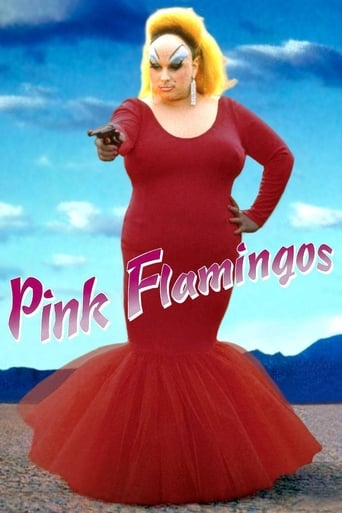
Pink Flamingos (1972)
An exercise in poor taste.
Notorious Baltimore criminal and underground figure Divine goes up against Connie & Raymond Marble, a sleazy married couple who make a passionate attempt to humiliate her and seize her tabloid-given title as "The Filthiest Person Alive".
- Date of release
- 1972-03-17
- TMDB
- 6.1 / 10 (597)
- Runtime
- 1h 33m
- Genres
- Comedy, Crime
- Director
- John Waters
Casting
- Divine — Divine / Babs Johnson
- David Lochary — Raymond Marble
- Mary Vivian Pearce — Cotton
- Mink Stole — Connie Marble
- Danny Mills — Crackers
- Edith Massey — Edie
- Channing Wilroy — Channing
- Cookie Mueller — Cookie
- Paul Swift — The Egg Man
- Susan Walsh — Suzie
- Linda Olgeirson — Linda
- Pat Moran — Patty Hitler (Party Guest in Nazi Uniform)
Interesting facts
- Box office: $6M
- Budget: $10K
- Earned 600× its budget
- Filmed in: Baltimore
Pink Flamingos is a 1972 American independent black comedy crime film by John Waters. It is part of what Waters has labelled the "Trash Trilogy", which also includes Female Trouble (1974) and Desperate Living (1977). The film stars the countercultural drag queen and actor Divine as a criminal living under the name of Babs Johnson, who is proud to be "the filthiest person alive". While living in a trailer with her mother Edie, son Crackers, and companion Cotton, Divine is confronted by the Marbles, a pair of criminals envious of her reputation who try to outdo her in filth.
Production
Divine's friend Bob Adams described the trailer set as a "hippie commune" in Phoenix, Maryland, and noted that their living quarters were in a farmhouse without hot water. Adams added that ultimately Divine and Van Smith decided to sleep at Susan Lowe's home in Baltimore, and that they would awake before dawn to apply Divine's makeup before being driven to the set by Jack Walsh.
Divine's mother, Frances, later said she was surprised that her son was able to endure the "pitiful conditions" of the set, noting his "expensive taste in clothes and furniture and food".
John Waters told an interviewer "I was high when I wrote this movie. I was NOT high when I filmed it."
Principal photography began October 1, 1971 and ended January 12, 1972. Shot on a budget of only $12,000, Pink Flamingos is an example of Waters' style of low-budget filmmaking inspired by New York underground filmmakers like Kenneth Anger, Andy Warhol, and brothers Mike and George Kuchar. Stylistically, it takes its cues from "exaggerated seaport ballroom drag-show pageantry and antics" with "classic '50s rock-and-roll kitsch classics".
Waters' rough editing added "random Joel-Peter Witkin-esque scratches and Stan Brakhage-moth-wing-like dust marks" to the film, apart from sound delays between shots. Waters has stated that Armando Bo's 1969 Argentine film Fuego influenced not only Pink Flamingos, but his other films: "If you watch some of my films, you can see what a huge influence Fuego was. I forgot how much I stole. ... Look at Isabel's makeup and hairdo in Fuego.
Read on Wikipedia · Text from Wikipedia, CC BY-SA 4.0. Data from Wikidata.
Recommended
- Desperate Living 1977 · ★ 6.3
- Female Trouble 1976 · ★ 6.9
- South Park (Not Suitable for Children) 2023 · ★ 7.5
- Hard to Die 1990 · ★ 6.0
- The Overnight 2015 · ★ 5.9
- Rise of the Footsoldier 2007 · ★ 6.3
- Foxy Brown 1974 · ★ 6.3
- Faster, Pussycat! Kill! Kill! 1965 · ★ 6.4
- Cotton Comes to Harlem 1970 · ★ 6.2
- Novocaine 2001 · ★ 6.1
- 68 Kill 2017 · ★ 5.9
- A Clockwork Orange 1971 · ★ 8.2