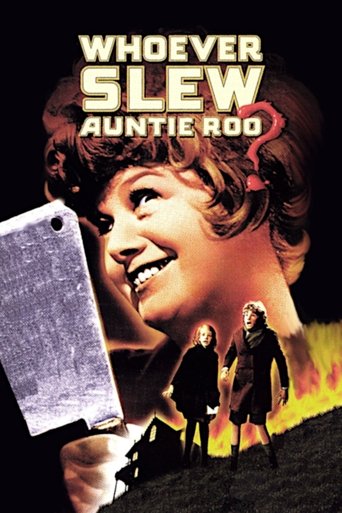
Whoever Slew Auntie Roo? (1972)
She's Taking a STAB at Motherhood!
Mrs Rosie Forrest, aka 'Auntie Roo', has a holiday tradition of inviting orphans to her mansion for a party. But Roo isn't completely sane; she lost her husband and is obsessed with her deceased daughter, whose corpse she still keeps in the house. When Katy Coombs sneaks into the party with her brother, Christopher, the deranged biddy abducts the young girl with the hopes of replacing her daughter.
- Date of release
- 1972-02-11
- TMDB
- 6.2 / 10 (77)
- Runtime
- 1h 31m
- Genres
- Horror, Thriller
- Director
- Curtis Harrington
Casting
- Shelley Winters — Mrs Rosie Forrest / 'Auntie Roo'
- Mark Lester — Christopher Coombs
- Chloe Franks — Katy Coombs
- Ralph Richardson — Mr Benton
- Lionel Jeffries — Police Insp. Willoughby
- Hugh Griffith — Mr Harrison, The Pigman
- Rosalie Crutchley — Miss Henley
- Pat Heywood — Dr Mason
- Judy Cornwell — Clarine
- Michael Gothard — Albie
- Jackie Cowper — Angela Barnes
- Richard Beaumont — Peter Brookshire
Interesting facts
- Budget: $800K
Whoever Slew Auntie Roo? is a 1971 British horror thriller film directed by Curtis Harrington and starring Shelley Winters, Mark Lester, Ralph Richardson, Chloe Franks, Judy Cornwell, Michael Gothard, Hugh Griffith and Lionel Jeffries. Inspired by the fairy tale "Hansel and Gretel", the film focuses on a demented American widow (Winters) living in her husband's English manor who becomes obsessed with a young orphan girl who resembles her dead daughter.
Production
The film was financed by American International Pictures (AIP) through its British subdivision AIP-England, Ltd. and Hemdale Film Corporation, who represented Mark Lester. It was one of three films financed by Hemdale (the others were Where Does It Hurt? and Love on Horseback) with a total budget of £1,250,000.
Curtis Harrington was going to direct Wuthering Heights in England for AIP, but did this instead after Shelley Winters requested him. Winters had worked with Harrington on What's the Matter with Helen? and asked for him on this movie "because of his ability with actors. I thought he would be wonderful." Harrington recalled it was not a project "I personally wanted particularly to do."
The film was based on a storyline from longtime Hammer horror writer Jimmy Sangster, inspired by Hansel and Gretel. AIP chiefs Samuel Z. Arkoff and James H. Nicholson hired Robert Blees to re-write the script. Dissatisfied with Blees' work, Harrington arranged to have the script rewritten again by Gavin Lambert, who was credited with 'additional dialogue'.
Even after this, Harrington said "It had a very weak, incredibly lousy script... what I finally shot is an incredible improvement over the original. Even so, it was very difficult to do enough with it to make it work."
Harrington says it was his idea to set the film in the 1920s, recalling: "I have a great fondness for all the imagery and quality of the traditional Victorian Christmas celebration. I tried to put as much as I could of that in the film."
Read on Wikipedia · Text from Wikipedia, CC BY-SA 4.0. Data from Wikidata.
Recommended
- Family Plot 1976 · ★ 6.8
- The Baby 1973 · ★ 6.0
- Now You See Me 2 2016 · ★ 6.8
- The Uninvited 1944 · ★ 6.9
- Palmetto 1998 · ★ 5.9
- The End of Oak Street 2026 · ★ 7.0
- The Cellar 2022 · ★ 6.4
- The Night Walker 1964 · ★ 6.4
- What Ever Happened to Baby Jane? 1962 · ★ 7.9
- The Shed 2019 · ★ 6.0
- Take Down 2016 · ★ 5.8
- Strange but True 2019 · ★ 6.0