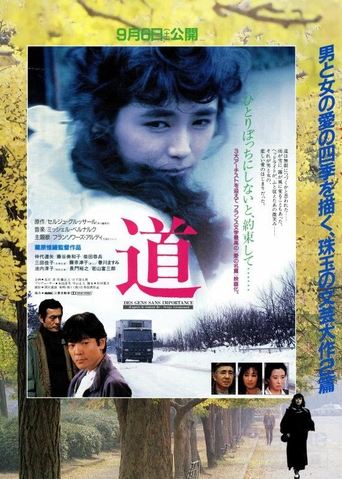
道 (1986)
A married long-distance truck driver falls for a significantly younger waitress at a roadside diner. Their affair brings tragedy to themselves and those around them.
- Data di uscita
- 1986-09-06
- TMDB
- 1.0 / 10 (2)
- Durata
- 2 h 13 min
- Generi
- Dramma, Romance
- Regista
- Koreyoshi Kurahara
Cast
- Tatsuya Nakadai — Seiji Tajima
- 若山富三郎 — Naokichi Sakura
- 地井武男 — Yukio
- 春川ますみ — Matsuyo
- 藤谷美和子 — Kazue Komiya
- 池内淳子 — Yoshiko Tajima
- 三田佳子 — Hideko
- 長門裕之 — Boss of the Mizuya clan
- Natsuko Fuji — Eri Tajima
- 柴田恭兵 — Minoru Shinozuka
- 中島葵 — Proprietress of Hanabishi
- 大林丈史 — Dispatch
Curiosità
Michi , also known as The Road, Des gens sans importance and Hopeless Love, is a 1986 Japanese tragic romantic drama film directed by Koreyoshi Kurahara and written by Hirô Matsuda. It is a remake of the 1956 French film Des gens sans importance directed by Henri Verneuil, itself based on a novel of the same name by Serge Groussard. Its plot concerns a married long-distance truck driver who falls for a significantly younger waitress at a diner, and the trouble this affair brings to both their lives.
Production
The project was conceived by Toei producers Gorô Kusakabe and Tatsuo Honda, both of whom were fans of the original film. They asked Koreyoshi Kurahara to direct, knowing that he drew inspiration from French filmmakers. Kurahara was concerned that the original film, made only a decade after World War II, could not be adapted to a Japan that had become prosperous in the bubble era.
Originally, the creative team wanted to hire Ken Takakura for the lead role, which would have reteamed Takakura with Kurahara after the massive success of Antarctica. This was later changed to Tatsuya Nakadai, as Takakura's fee had risen to ¥30 million per film, plus a commission of 2% of the distribution revenue, the highest amount ever paid to a Japanese actor at the time.
Michi marked the second collaboration between director Kurahara and Tatsuya Nakadai, following Safari 5000 (1969). Nakadai had been a fan of Jean Gabin, who portrayed the protagonist in the original, since he was young. As a result, Nakadai struggled with preparation for the role from the time he accepted it until filming began. He later said, "If you think about it, it's similar to how many different actors play Hamlet.
Filming began in December 1985. Shooting took place across Japan, including the prefectures of Niigata, Aomori, Aichi, Osaka, Wakayama, Tottori and Yamaguchi. Specific shooting locations included Tottori, Yonago, Nagoya, Shimonoseki and Tokyo, as well as nighttime filming in Kabukichō, Shinjuku. Production was briefly suspended around February 20, but resumed on March 20, and wrapped in late May 1986.
Miwako Okamura was reportedly difficult to work with, refusing to come out of her hotel room and complaining of headaches. Producer Gorô Kusakabe later wrote, "Being with an actress who has been pampered since she was a teenager when she didn't know much about anything is much more tiring than dealing with a Hiroshima yakuza.”
Leggi su Wikipedia · Testo da Wikipedia, CC BY-SA 4.0. Dati da Wikidata.
Consigliati
- Cuori di vetro 2009 · ★ 6.3
- Amore inaspettato 2017 · ★ 6.1
- It Feels So Good 2019 · ★ 6.6
- Newness 2017 · ★ 6.1
- The Secret: La forza di sognare 2020 · ★ 7.4
- Qualcuno da amare 1993 · ★ 6.9
- Purple Hearts 2022 · ★ 8.0
- Tra due fuochi 1986 · ★ 6.2
- The Good Neighbor 2022 · ★ 6.6
- Gabriel's Inferno: Part III 2020 · ★ 8.3
- Love Everlasting 2016 · ★ 7.4
- Un amore senza fine 2014 · ★ 6.9