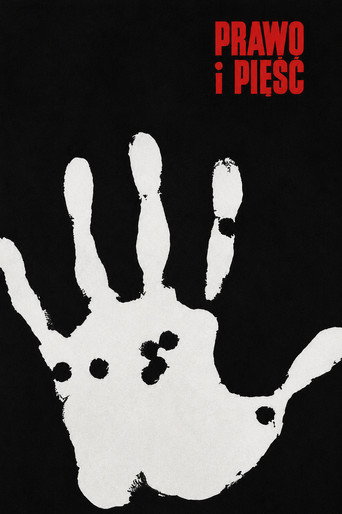
Prawo i pięść (1964)
At the end of World War Two, Polish people move to the western lands vacated by Germans. But some ruthless profiteers pose as government representatives and intend to make off with loot from a deserted town they took over. One honest man stands up against them because he believes these goods belong to the people.
- Data di uscita
- 1964-09-14
- TMDB
- 7.0 / 10 (15)
- Durata
- 1 h 30 min
- Generi
- Guerra, Dramma
- Regista
- Edward Skórzewski, Jerzy Hoffman
Cast
- Gustaw Holoubek — Andrzej Kenig
- Zofia Mrozowska — Anna
- Hanna Skarżanka — Barbara Dubikowska
- Wiesław Gołas — Smółka
- Zdzisław Maklakiewicz — Czesiek
- Ryszard Pietruski — Wijas
- Jerzy Przybylski — "Doctor" Mielecki
- Wiesława Kwaśniewska — Zośka
- Ewa Wiśniewska — Janka
- Zbigniew Dobrzyński — Rudłowski
- Zofia Czerwińska — Attacked Repatriate
- Józef Nowak — Lieutenant Wrzesiński
Curiosità
Prawo i pięść is a 1964 Polish post-war Eastern drama film directed by Jerzy Hoffman and Edward Skórzewski. Based on a 1964 novel of the same name by Józef Hen, the film sparked a lively reaction among critics: some praised its adaptation of Western conventions to the Polish context, while others criticized it for being merely an imitation of American Westerns. It has since achieved cult status and is regarded as a significant work in the history of Polish cinema.
Production
After making the 1962 comedy Gangsterzy i filantropi, Jerzy Hoffman and Edward Skórzewski—whose subsequent comedy scripts had been rejected—decided to switch genres. "We realized we had to do something in a different genre, because our satire was too critical of the system, and they wouldn't let us make that kind of film anymore".
Exterior scenes were shot in Toruń as well as in Koronowo, Ciechocinek, and Chełmża. A ballad titled "Nim wstanie dzień" was recorded for the film, featuring music by Krzysztof Komeda and lyrics by Agnieszka Osiecka; it was performed by the actor Edmund Fetting, who did not appear in the film itself.
Leggi su Wikipedia · Testo da Wikipedia, CC BY-SA 4.0. Dati da Wikidata.
Consigliati
- Volo senza ritorno 1942 · ★ 6.6
- La spia della Resistenza 2019 · ★ 6.2
- Squadrone 303 - La grande battaglia 2018 · ★ 5.9
- Uomini in guerra 1957 · ★ 6.6
- Sfida agli inglesi 1957 · ★ 6.8
- Katyn 2007 · ★ 6.7
- Hurricane 2018 · ★ 5.9
- Generazione 1955 · ★ 6.9
- Bastogne 1949 · ★ 6.7
- Aspettando Anya 2020 · ★ 6.3
- Warsaw 44 2014 · ★ 6.7
- Belva di guerra 1988 · ★ 7.1