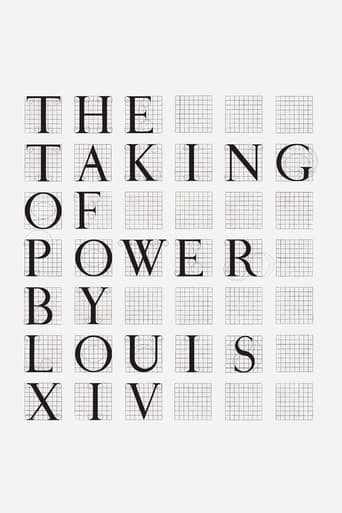
The Taking of Power by Louis XIV (1966)
La Prise de pouvoir par Louis XIV
Cardinal Mazarin dies, leaving a power vacuum in which the young Louis asserts his intention to govern as well as rule. Mazarin's fiscal advisor, Colbert, warns against Fouquet, the Superintendant who has been systematically looting the treasury and wants to be prime minister. Fouquet believes Louis will soon tire of exercizing power and overplays his hand by offering a bribe to Louis' mistress to be his ally. She reports this to the king who arrests Fouquet. Louis and Colbert design a brilliant strategy to keep merchants making money, nobles in debt, the urban poor working and fed, and peasants untaxed.
- Date of release
- 1966-11-09
- TMDB
- 7.1 / 10 (55)
- Runtime
- 1h 35m
- Genres
- TV Movie, Drama, History
- Director
- Roberto Rossellini
Casting
- Jean-Marie Patte — King Louis XIV
- Raymond Jourdan — Jean Baptiste Colbert
- Silvagni — Cardinal Mazarin
- Katharina Renn — Anne d'Autriche
- Dominique Vincent — Madame du Plessis
- Pierre Barrat — Nicolas Fouquet
- Fernand Fabre — Michel Le Tellier
- Françoise Ponty — Louise de la Vallière
- Joëlle Laugeois — Marie-Thérèse
- Maurice Barrier — D'Artagnan
- André Dumas — Father Joly
- François Mirante — Monsieur de Brienne
Interesting facts
The Taking of Power by Louis XIV, also called The Rise of Louis XIV, is a 1966 French television film directed by the Italian Roberto Rossellini and written by Philippe Erlanger and Jean Gruault. It describes how the young king Louis XIV and his lieutenant Jean-Baptiste Colbert restructured French politics and undermined their noble rivals to create an absolute monarchy. Richard Brody wrote that the film "traces the rise of modern French culture—indeed, of modern France—to very specific moments in the young king's struggle to preserve his fragile reign."
Development and themes
At the end of his career, celebrated director Roberto Rossellini decided to focus on historical films, most of which were made-for-TV. Unlike most of Rossellini's histories, however, Rossellini did not join the creative team of The Taking of Power by Louis XIV until relatively late in the process.
In keeping with his neorealist style, Rossellini hired mostly non-professional actors; as director Paul Schrader put it, "[t]here is little 'acting' per se," and the actors "recite their lines rotely and without inflection." Jean-Marie Patte, who played the king, was an office clerk. (He later became a playwright and theater director.) Director Wes Anderson remarked that Patte "cannot give a convincing line reading ...
The film's style seeks to avoid overt editorialization. Even so, the film ambiently delivers its verdict, as it "hopes to draw a moral truth, not simply a factual truth." Derek Malcolm described the film as a "didactic reconstruction[] of history," emphasizing how "[t]he triumph of appearance over reality is apparent everywhere." Schrader notes that the falseness of the French court, exemplified by Mazarin putting on makeup to impress the king on…
Read on Wikipedia · Text from Wikipedia, CC BY-SA 4.0. Data from Wikidata.
Recommended
- The Death of Louis XIV 2016 · ★ 6.5
- The Flood 2024 · ★ 6.4
- The King Is Dancing 2000 · ★ 6.5
- My Dinner with Hervé 2018 · ★ 6.3
- Victoria & Abdul 2017 · ★ 6.9
- The Royal Exchange 2017 · ★ 6.2
- Marie Antoinette 2006 · ★ 6.7
- Miss Violet 2024 · ★ 6.9
- Napoleon 1927 · ★ 7.9
- The Audrey Hepburn Story 2000 · ★ 6.2
- Chouans ! 1988 · ★ 5.8
- The Girl 2012 · ★ 6.2