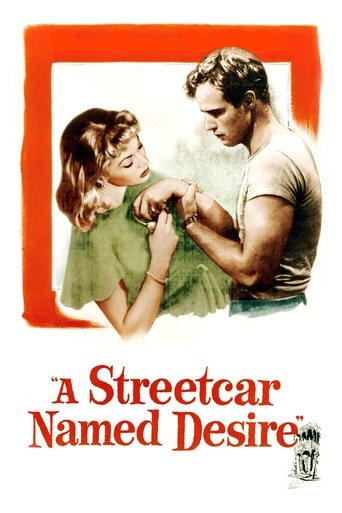
A Streetcar Named Desire (1951)
...Blanche, who wanted so much to stay a lady...
A disturbed, aging Southern belle moves in with her sister for solace — but being face-to-face with her brutish brother-in-law accelerates her downward spiral.
- Date of release
- 1951-09-18
- TMDB
- 7.6 / 10 (1557)
- Runtime
- 2h 2m
- Genres
- Drama
- Director
- Elia Kazan
Casting
- Vivien Leigh — Blanche DuBois
- Marlon Brando — Stanley Kowalski
- Kim Hunter — Stella Kowalski
- Karl Malden — Harold Mitchell
- Rudy Bond — Steve
- Nick Dennis — Pablo Gonzales
- Peg Hillias — Eunice
- Wright King — A Collector
- Richard Garrick — A Doctor
- Ann Dere — The Matron
- Edna Thomas — The Mexican Woman
- Mickey Kuhn — A Sailor
Interesting facts
- Box office: $8M
- Budget: $1.8M
- Earned 4.4× its budget
- Based on: A Streetcar Named Desire and A Streetcar Named Desire
- Filmed in: New Orleans
- Awards: 7 · Nominations: 15. Including: Grand Jury Prize of the Venice Film Festival; Academy Award for Best Supporting Actress; Academy Award for Best Supporting Actor; Academy Award for Best Actress
A Streetcar Named Desire is a 1951 American Southern Gothic drama film adapted from Tennessee Williams' Pulitzer Prize-winning play of the same name. Directed by Elia Kazan, it stars Vivien Leigh, Marlon Brando, Kim Hunter, and Karl Malden. The film tells the story of a Mississippi Southern belle, Blanche DuBois (Leigh), who, after encountering a series of personal losses, seeks refuge with her sister (Hunter) and brother-in-law (Brando) in a dilapidated New Orleans apartment building. The original Broadway production and cast was converted to film, albeit with several changes and sanitizations related to censorship.
Production
A Streetcar Named Desire was adapted directly from the successful 1947 Broadway production of the play, which won the New York Drama Critics' Circle Award for Best Play and the Pulitzer Prize for Drama. Many of the cast and crew were ported over from the stage production, including director Elia Kazan and actors Marlon Brando, Kim Hunter, Karl Malden, Rudy Bond, Nick Dennis, Peg Hillias, Ann Dere, Edna Thomas, and Richard Garrick.
Aside from the opening and closing scenes, which were shot on location in New Orleans, A Streetcar Named Desire was filmed entirely on soundstages at the Warner Bros. Studios in Burbank, California. The Kowalski apartment was designed to gradually appear smaller over the course of the film, in order to reflect the tension between the characters.
For the opening scene, #922 was chosen to be the streetcar that dropped off Blanche. As of 2022, this streetcar was still in service on the St. Charles Streetcar Line.
Several scenes were cut after filming was completed in order for the film to conform to the Hays Code and avoid condemnation by the National Legion of Decency. In 1993, after Warner Bros. rediscovered the censored footage during a routine inventory of archives, an "original director's version" video re-release restored it.
Read on Wikipedia · Text from Wikipedia, CC BY-SA 4.0. Data from Wikidata.
Recommended
- Rachel Getting Married 2008 · ★ 6.3
- The Color Purple 2023 · ★ 7.0
- Cat on a Hot Tin Roof 1958 · ★ 7.6
- Blue Jasmine 2013 · ★ 7.0
- Sleepwalking 2008 · ★ 6.1
- To Kill a Mockingbird 1962 · ★ 8.0
- Marvin's Room 1996 · ★ 6.7
- Interiors 1978 · ★ 6.8
- Cassandra's Dream 2007 · ★ 6.3
- East of Eden 1955 · ★ 7.5
- The Fabelmans 2022 · ★ 7.5
- The Boys of St. Vincent 1994 · ★ 7.1