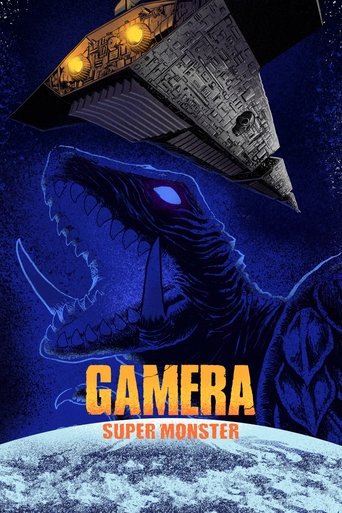
Gamera Super Monster (1980)
宇宙怪獣ガメラ
The universe's strongest Super Monster has finally arrived!
As a massive alien craft heads to Earth to do evil, three good and powerful superwomen befriend a young boy who has a special connection to Gamera. The alien Zanon launches a battery of familiar foes against Gamera, who might have to give the ultimate sacrifice to defeat the alien invader.
- Date of release
- 1980-03-20
- TMDB
- 4.9 / 10 (61)
- Runtime
- 1h 32m
- Genres
- Science Fiction, Family, Action
- Director
- Noriaki Yuasa
- Collection
- Gamera (Showa) Collection
Casting
- Mach Fumiake — Kilara
- Yaeko Kojima — Marsha
- Yoko Komatsu — Mitan
- Keiko Kudo — Giruge
- Koichi Maeda — Keiichi
- Toshie Takada — Keiichi's Mother
- Kisao Tobita — Driver
- Osamu Kobayashi — 'Zanon' Captain (voice)
- Hiroji Hayashi — Delinquent Boy A
- Tetsuaki Toyosumi — Delinquent Boy B
- Hideki Kobayashi — Delinquent Boy C
- Makoto Ikeda — Keiichi's Friend
Interesting facts
Gamera: Super Monster is a 1980 Japanese kaiju film directed by Noriaki Yuasa and produced by Daiei International. It is the eighth film in the Gamera film series and its first installment by Tokuma Shoten, following the release of Gamera vs. Zigra in 1971, while it is a new story and doesn't share the lore with the previous Showa films.
Production
Gamera: Super Monster was the first post-Daiei installment of the franchise by Tokuma Shoten and was produced as an attempt to help Daiei get out of its turbulent financial situation. The Totsu ECG System was utilized for filming.
It contains extensive stock footages of the entire Showa Gamera film series, as well as Space Battleship Yamato and Galaxy Express 999, where the producer Masaya Tokuyama also participated in the promotion of Galaxy Express 999 (1979). KochiKame: Tokyo Beat Cops and Kinnikuman were also briefly featured and parodied.
Most footage of Gamera and his enemies are re-edited stock footages from previous films due to budgetary and schedule constraints and insufficient materials; this movie would have costed at least ¥1 billion if it was entirely a new production. This direction to rely on Daiei Film properties was also shaped by the success of the 1979 Ultraman video film (jp) by Akio Jissoji which contributed in the revival of the Tsuburaya Productions franchise.
Various materials were lost during the turmoil when Daiei Film was officially declared bankrupt in December 1971, where a number of suits and props and equipments were destroyed by frustrated and distressed employees, either Noriaki Yuasa himself or a riot among staffs. Newly produced tokusatsu scenes to involve Gamera were almost exclusively filmed with the props of flying Gamera, which were preserved at the Ex Productions and evaded the riot.
Tamotsu Taga, one of former Daiei Film staffs who had abandoned the near-bankrupt company for P Productions due to the aftermaths of the scrapped project Giant Horde Beast Nezura prior to Gamera, the Giant Monster (1965), participated in Gamera: Super Monster as an editor along with additional crews from P Productions such as Shigeru Shinohara and Hirochika Muraishi.
Read on Wikipedia · Text from Wikipedia, CC BY-SA 4.0. Data from Wikidata.
Recommended
- Gamera vs. Barugon 1966 · ★ 6.4
- Invasion of Astro-Monster 1965 · ★ 6.8
- Gamera vs. Gyaos 1967 · ★ 6.1
- Attack on Titan II: End of the World 2015 · ★ 6.3
- Ghidorah, the Three-Headed Monster 1964 · ★ 7.0
- Godzilla x Kong: The New Empire 2024 · ★ 7.0
- Shin Ultraman 2022 · ★ 7.5
- The War of the Gargantuas 1966 · ★ 6.3
- King Kong vs. Godzilla 1962 · ★ 6.9
- Gigantis, the Fire Monster 1959 · ★ 6.4
- Destroy All Monsters 1968 · ★ 6.9
- Godzilla vs. Megalon 1973 · ★ 6.2