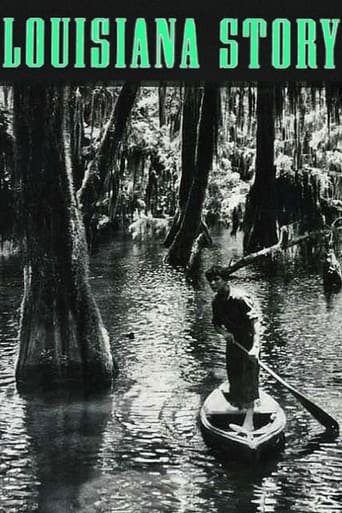
Louisiana Story (1948)
Cajun boy Alexander Napoleon Ulysses LaTour lives with his family and his beloved pet raccoon in the Louisiana bayou. When his father allows an oil barge to drill on their land, the boy questions the process and its safety.
- Date of release
- 1948-09-28
- TMDB
- 6.3 / 10 (51)
- Runtime
- 1h 18m
- Genres
- Adventure, Drama
- Director
- Robert Flaherty
Casting
- Joseph Boudreaux — The Boy
- Lionel Le Blanc — His Father
- E. Bienvenu — His Mother
- Frank Hardy — The Driller
- C.P. Guedry — His Boilerman
Interesting facts
- Awards: 1 · Nominations: 1. Including: National Board of Review: Top Ten Films
Louisiana Story is a 1948 American black-and-white drama film directed and produced by Robert J. Flaherty. The script was written by Flaherty and his wife Frances H. Flaherty. Although it has historically been represented as a documentary film, the events and characters depicted are fictional. The film was commissioned by the Standard Oil Company to promote its drilling ventures in the Louisiana bayous.
Production
Louisiana Story was shot on location over the course of 15 months in the Louisiana bayou country, using local residents for actors. Producer Robert J. Flaherty spent three months searching for a locale before filming began.
Although the film was sponsored by the Standard Oil Company, the company's name is not heard or seen, and Flaherty retained full ownership of the film. Of the approximately 300,000 feet of negative film shot, only about 8,000 feet were used in the final cut. Standard Oil used some of the remaining film to create two short promotional films. The film's budget was $258,000.
The boy, named in the film as Alexander Napoleon Ulysses Le Tour, but in the credits just identified as "the boy", is played by Louisiana native Joseph Boudreaux. When filming a scene involving a fight with an alligator, Boudreaux was so adept at subduing the alligator that the film crew tied a rope around his waist to pull him back to the shore to make the struggle seem more realistic.
The film was photographed by Richard Leacock and edited by Helen van Dongen, who were also the associate producers. It was distributed by the independent Lopert Films.
In 1952, it was reissued by an exploitation film outfit with a new title, Cajun, on the bottom half of a double bill with another film titled Watusi.
Read on Wikipedia · Text from Wikipedia, CC BY-SA 4.0. Data from Wikidata.
Recommended
- Thunder Bay 1953 · ★ 6.0
- Deepwater Horizon 2016 · ★ 6.9
- Black Gold 2011 · ★ 6.5
- Deliverance 1972 · ★ 7.3
- Sarah's Oil 2025 · ★ 7.9
- My Penguin Friend 2024 · ★ 7.4
- North Sea Hijack 1980 · ★ 6.3
- The Last of the Mohicans 1920 · ★ 6.3
- Abraham 1993 · ★ 7.2
- End of the Spear 2005 · ★ 6.3
- Flight of the Phoenix 2004 · ★ 6.0
- Beasts of the Southern Wild 2012 · ★ 6.8