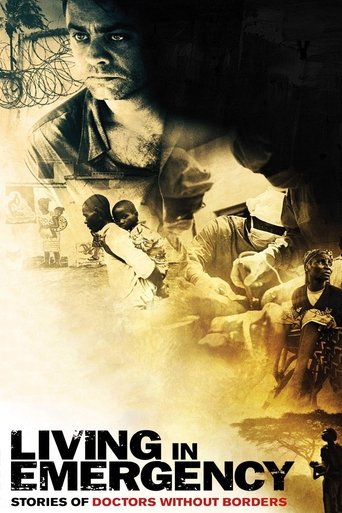
Living in Emergency: Stories of Doctors Without Borders (2008)
Higher Stakes. Tougher Choices. Medicine like you've never seen it.
In the war-zones of Liberia and Congo, four volunteers with Doctors Without Borders struggle to provide emergency medical care under extreme conditions. With different levels of experience, each volunteer must find their own way to face the challenges, the tough choices, and the limits of their idealism. "Living in Emergency" is a window into the seldom portrayed and less-than glamorous side of humanitarian aid work. It explores a world that is challenging, complex, and fraught with dilemmas - the struggles, both internal and external, that aid workers face when working in war zones and other difficult contexts.
- Date of release
- 2008-08-29
- TMDB
- 6.7 / 10 (6)
- Runtime
- 1h 33m
- Genres
- Documentary
- Director
- Mark N. Hopkins
Casting
- Davinder Gill — Himself
- Chris Brasher — Himself
- Tom Krueger — Himself
- Chiara Lepora — Herself
Interesting facts
- Filmed in: Democratic Republic of the Congo
Living in Emergency: Stories of Doctors Without Borders is a 2008 American documentary film directed by Mark N. Hopkins. It was among the 15 documentaries shortlisted for the Best Documentary Oscar by the Academy of Motion Picture Arts and Sciences for the 82nd Academy Awards.
Production
It took six months for the filmmakers to persuade MSF to grant them unrestricted access to film the field operations. More than 25 production companies had tried and been rejected.
Undeterred, director Mark N. Hopkins and his team produced a 15-minute pilot about the organization's emergency response to the 2005–06 Niger food crisis and were consequently given permission.
For a period of two years the team filmed in various MSF hospitals. The shoots were organized to cover the various facets of the MSF organization: the administrative base, the conflict and post-conflict missions, and a response to natural disaster.
The film was shot in Liberia after the Second Civil War and in the North-East of the Democratic Republic of Congo where there is still ongoing conflict after the Second Congo War.
Read on Wikipedia · Text from Wikipedia, CC BY-SA 4.0. Data from Wikidata.
Recommended
- Come See Me in the Good Light 2025 · ★ 6.9
- Directed by John Ford 1971 · ★ 7.0
- Anna Nicole Smith: You Don't Know Me 2023 · ★ 6.1
- Naqoyqatsi 2002 · ★ 6.2
- Jim: The James Foley Story 2016 · ★ 7.2
- A Toxic Love Story 2026 · ★ 6.5
- Burma VJ: Reporting from a Closed Country 2008 · ★ 7.3
- We Live in Public 2009 · ★ 6.8
- The Curious Birth of Benjamin Button 2009 · ★ 7.0
- Trainwreck: The Real Project X 2025 · ★ 5.9
- My Mom Jayne 2025 · ★ 8.0
- The Curse of the Dragon 1993 · ★ 7.2