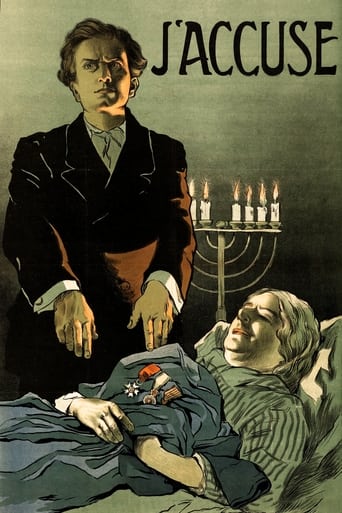
我控诉 (1919)
J'accuse
第一次世界大战敲响二十世纪的第一记警钟,从国际布局、人文精神到文艺和电影,都深受震撼和启发。阿贝尔冈斯透过三个人的爱情和友谊,反抗战争的风暴,并呈现面对国家和战争的思想矛盾,叩问人性和文艺的价值。悲壮的结局,饱含失落与不断战胜失落的愿望,正是视频不衰的意义。冈斯终生热衷于叙事和图像实验,风格今天看来依然前卫先锋。本片与其后的《拿破仑》(1927)同为冈斯的钜构,技法多样而热情,拓展了电影的艺术语言。
- 上映日期
- 1919-04-25
- TMDB
- 7.4 / 10 (70)
- 片长(分钟)
- 2小时46分钟
- 类型
- 战争, 剧情
- 导演
- Abel Gance
演员阵容
- Romuald Joubé — Jean Diaz
- Séverin-Mars — François Laurin
- Maryse Dauvray — Edith Laurin
- Maxime Desjardins — Maria Lazare
- Angèle Guys — Angèle
- Mancini — Jean's Mother (uncredited)
- Elizabeth Nizan — (uncredited)
- Pierre Danis — (uncredited)
- Paul Duc — Orphan (uncredited)
趣闻
J'accuse is a 1919 French silent film directed by Abel Gance. It juxtaposes a romantic drama with the background of the horrors of World War I, and it is sometimes described as a pacifist or anti-war film. Work on the film began in 1918, and some scenes were filmed on real battlefields. The film's powerful depiction of wartime suffering, particularly its climactic sequence of the "return of the dead", made it an international success and confirmed Gance as one of the most important directors in Europe.
Production
Abel Gance had been drafted into the French Army's Section Cinématographique during World War I, but he was later discharged because of ill health, a piece of good fortune to which he later said he owed his life. He had already formulated the idea for J'accuse.
The sequence of the "return of the dead" at the end of the film was shot in the south of France by using 2000 soldiers who had come back on leave. Gance recalled: "The conditions in which we filmed were profoundly moving.... These men had come straight from the Front – from Verdun – and they were due back eight days later.
For the film's opening title, a large group of soldiers, filmed from above, is formed up to shape the letters J...A...C...C...U...S...E. In the middle of preparing the shot, a general asked Gance what was happening. Gance stalled until the shot was complete and then explained to the startled general that he was "accusing the war... accusing men...
Asked whether he regarded J'accuse was a pacifist film, Gance replied: "I'm not interested in politics.... But I am against war, because war is futile. Ten or twenty years afterward, one reflects that millions have died and all for nothing.
The technical quality of the film was impressive, especially the cinematography of Léonce-Henri Burel with its subtle use of lighting effects and a mobile camera. For the battle scenes in the last section of the film Gance also introduced some of the techniques of rapid editing which he would develop much further in his later films La Roue and Napoléon.
在维基百科阅读更多 · 文本来自维基百科,CC BY-SA 4.0。数据来自 Wikidata。