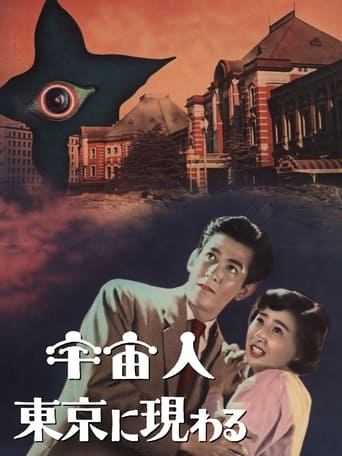
宇宙人東京に現わる (1956)
Large star-shaped aliens travel to earth in hopes of warning them about an oncoming catastrophe. To prevent panic about their appearance, one alien takes the form of a popular singer.
- Erscheinungsdatum
- 1956-01-29
- TMDB
- 5.3 / 10 (41)
- Laufzeit
- 1 Std. 27 Min.
- Genres
- Science Fiction, Horror
- Regie
- 島耕二
Besetzung
- 川崎敬三 — Dr. Toru Itsobe
- Toyomi Karita — Hikari Aozora / Ginko
- 北城寿太郎 — No. 2 Pairan
- 南部彰三 — The Elder Dr. Itsobe
- 見明凡太朗 — Dr. Kamura
- Mieko Nagai — Taeko Kamura
- 平井岐代子 — Mrs. Matsuda
- 山形勲 — Dr. Matsuda
- 目黒幸子
- 岡村文子
- 渡辺鉄弥
- 夏木章
Wissenswertes
Warning from Space is a 1956 Japanese science fiction film directed by Koji Shima. It was written by Hideo Oguni based on Gentaro Nakajima's novel. In the tokusatsu film's plot, starfish-like aliens "Pairan" disguised as humans travel to Earth to warn of the imminent collision of a rogue planet and Earth. As the planet rapidly accelerates toward Earth, a nuclear device is created at the last minute and destroys the approaching world.
Production
After the success of Toho's 1954 film Godzilla, which depicted a giant dinosaur attacking Tokyo, many Japanese film studios began to produce similar monster films, including Warning from Space. Along with other films such as Shintōhō's Fearful Attack of the Flying Saucers and the American Forbidden Planet, Warning from Space became part of a fledgling subgenre of films based around science fiction creatures.
The Pairan aliens were designed by Tarō Okamoto, which used a single eye that is common among science fiction aliens. Although official film posters showed the Pairan aliens towering over buildings, the actual cinematic version of the aliens were on the scale of humans, at about two meters. Walt Lee reports that Gentaro Nakajima's novel, on which this film was based, was in turn based on the Japanese folktale Kaguya-hime.
Its plot to depict appearances of extraterrestrials and astronomical object bears similarities to classic productions such as End of the World (1931), The Day the Earth Stood Still (1951), When Worlds Collide (1951), and The War of the Worlds (1953).
The Japanese title of Warning from Space bears the term "appear" (現わる, arawaru); it had been repeatedly used by Daiei Film at that time including The Invisible Man Appears, the Japanese title of The Beast from 20,000 Fathoms, which later influenced the production of Gamera, the Giant Monster, and Gamera-related post-Daiei productions, Giant Monsters Appear in Tokyo by Shochiku, and Giant God Warrior Appears in Tokyo by Studio Ghibli.
The Invisible Man Appears and Rainbow Man were the first post-war science fiction films in Japan. The two films were also produced under Masaichi Nagata, and involved Eiji Tsuburaya and Sadamasa Arikawa and Shuzaburo Araki in productions; the three participated in these films with their intentions to join Daiei Film, however they eventually returned to Toho and contributed in Godzilla (1954).
Auf Wikipedia weiterlesen · Text aus Wikipedia, CC BY-SA 4.0. Daten aus Wikidata.
Empfohlen
- X 3000 - Fantome gegen Gangster 1964 · ★ 6.7
- Rodan - Die fliegenden Monster von Osaka 1956 · ★ 6.5
- Godzilla 1954 · ★ 7.6
- Godzilla vs. Spacegodzilla 1994 · ★ 6.7
- Godzilla 2000: Millennium 1999 · ★ 6.9
- Returner - Kampf um die Zukunft 2002 · ★ 6.6
- Pacific Rim 2013 · ★ 6.9
- Die Körperfresser kommen 1978 · ★ 7.2
- King-Kong, Frankensteins Sohn 1967 · ★ 6.1
- Monster des Grauens greifen an 1970 · ★ 6.4
- Shin Ultraman 2022 · ★ 7.5
- Gamera - Attack of the Legion 1996 · ★ 7.5