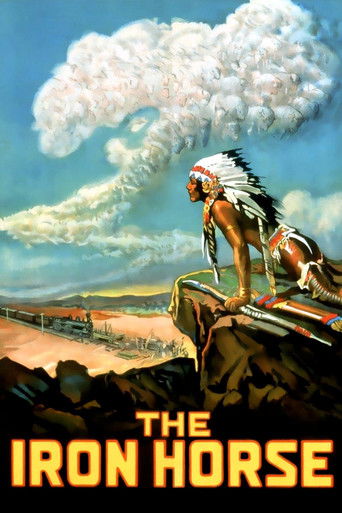
The Iron Horse (1925)
THE WEDDING OF THE RAILS! ONE OF AMERICA'S MOST THRILLING HISTORICAL DEEDS--THE DRIVING OF THE LAST SPIKE FOR THE TRANSCONTINENTAL RAILROAD
Brandon, a surveyor, dreams of building a railway to the west. He sets off with his son, Davy, to survey a route. They discover a new pass which will shave 200 miles off the expected distance, but they are set upon by a party of Cheyenne. One of them, a white renegade with only two fingers on his right hand, kills Brandon and scalps him. Davy is all alone now.
- Date of release
- 1925-10-04
- TMDB
- 6.8 / 10 (87)
- Runtime
- 2h 29m
- Genres
- Western, Drama, History, Romance
- Director
- John Ford
Casting
- George O'Brien — Davy Brandon
- Madge Bellamy — Miriam Marsh
- Charles Edward Bull — Abraham Lincoln
- Cyril Chadwick — Jesson
- Will Walling — Thomas Marsh
- Francis Powers — Sergeant Slattery
- J. Farrell MacDonald — Corporal Casey
- Jim Welch — Private Mackay
- George Waggner — Buffalo Bill
- Fred Kohler — Bauman
- James A. Marcus — Judge Haller
- Gladys Hulette — Ruby
Interesting facts
- Box office: $942.9K
- Budget: $280K
- Earned 3.4× its budget
The Iron Horse is a 1924 American silent epic Western film directed by John Ford and produced by Fox Film. It was the studio's hastily planned response to the success of Paramount Pictures' The Covered Wagon. The studio gave Ford his first major budget, which he exceeded. The gamble paid off, and The Iron Horse was an enormous success. The film marked the beginning of Ford's strong association with Westerns.
Production
William Fox gave John Ford $450,000 to create a picture that would rival Paramount's The Covered Wagon, which had earned millions in 1923. Since it was shot on location, Fox sent Ford to shoot in Wadsworth, Nevada. Sol Wurtzel solved the town's lack of hotels by renting sleeper cars from Al G. Barnes Circus. The cast and crew of 200 left Los Angeles on New Year's Eve 1923.
Most of the Californians were underdressed for temperatures that were below zero and they took to wearing their costumes to stay warm. Barnes' cars were flea-ridden. The result was an impromptu Camp Ford where people slept in tents and the movie sets.
The cast was a broad mix of ethnicities, including Chinese men who had worked as coolies building the Central Pacific. Members of Cheyenne, Paiute, Pawnee, and Sioux tribes played Native Americans in the film. They would also stand in as Chinese and vice versa.
Ford was injured while filming the buffalo stampede. He was positioned in a plank-covered trench when some animals ran over his location. Wurtzel was so encouraged by the rushes that he urged Ford to continue. Ford's older brother Eddie worked as his assistant and ran interference with the studio. Their uncle had laid track for the Union Pacific, and when the difficult shoot wrapped, Ford felt they had experienced something similar.
The film accurately depicts a notable episode during the construction of the Central Pacific route when supply trains had to be hauled overland. Central Pacific loaned Ford its engine No. 3, "C.P. Huntington". 50 horses were hitched to the front of the locomotive while dozens of men pushed from the back. The production also relied on a hidden wires attached to another train to inch the C.P. Huntington along on a sled in the scene. C.P.
Read on Wikipedia · Text from Wikipedia, CC BY-SA 4.0. Data from Wikidata.
Recommended
- Broken Arrow 1950 · ★ 6.7
- Hombre 1967 · ★ 7.0
- The Way West 1967 · ★ 6.1
- The Call of the Wild 1972 · ★ 6.1
- Return of the Bad Men 1948 · ★ 6.3
- News of the World 2020 · ★ 6.9
- The Big Sky 1952 · ★ 6.6
- The Big Trail 1930 · ★ 6.8
- Love Finds You in Valentine 2016 · ★ 6.4
- Tell Them Willie Boy Is Here 1969 · ★ 5.8
- Dances with Wolves 1990 · ★ 7.8
- Oklahoma! 1955 · ★ 6.6