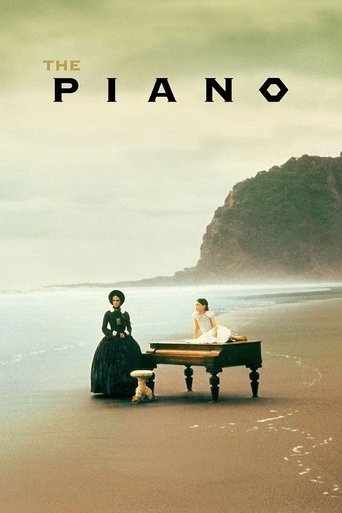
The Piano (1993)
Silence affects everyone in the end.
When an arranged marriage brings Ada and her spirited pre-teen daughter Flora to the wilderness of 19th-century New Zealand, she finds herself locked in a battle of wills with both her controlling husband and a rugged frontiersman to whom she develops a forbidden attraction.
- Date of release
- 1993-05-18
- TMDB
- 7.4 / 10 (1726)
- Runtime
- 2h 0m
- Genres
- Drama, Romance
- Director
- Jane Campion
Casting
- Holly Hunter — Ada McGrath
- Harvey Keitel — George Baines
- Sam Neill — Alisdair Stewart
- Anna Paquin — Flora McGrath
- Cliff Curtis — Mana
- Kerry Walker — Aunt Morag
- Ian Mune — Reverend
- Geneviève Lemon — Nessie
- Pete Smith — Hone
- Bruce Allpress — Blind Piano Tuner
- Rose McIver — Angel
- Verity George — Bluebeard's Wife
Interesting facts
- Box office: $40.2M
- Filmed in: New Zealand
- Awards: 32 · Nominations: 59. Including: Academy Award for Best Supporting Actress; Academy Award for Best Actress; Academy Award for Best Writing, Original Screenplay; AACTA Award for Best Film
The Piano is a 1993 historical romance film written and directed by Jane Campion. It stars Holly Hunter, Harvey Keitel, Sam Neill, and Anna Paquin in her first major acting role. The film focuses on a mute Scottish woman who travels to a remote part of New Zealand with her young daughter after her arranged marriage to a settler. The plot has similarities to Jane Mander's 1920 novel, The Story of a New Zealand River, but also substantial differences. Campion has cited the novels Wuthering Heights and The African Queen as inspirations.
Production
The film was originally titled The Piano Lesson, but the filmmakers could not obtain the rights to use the title because of the American play of the same name, and it was changed to The Piano.
Casting the role of Ada was a difficult process. Sigourney Weaver was Jane Campion's first choice, but she was not interested. Jennifer Jason Leigh was also considered, but had a conflict with her commitment to Rush (1991). Isabelle Huppert met with Campion and had vintage period-style photographs taken of her as Ada, and later said she regretted not fighting for the role as Holly Hunter did.
The casting for Flora occurred after Hunter had been selected for the part. They did a series of open auditions for girls age 9 to 13, focusing on girls who were small enough to be believable as Ada's daughter (as Hunter is relatively short at 157 cm; 5 ft 2 in tall). Anna Paquin ended up winning the role of Flora over 5,000 other girls.
Hunter collaborated extensively with Pierce College sign language instructor Darlene Allen Wittman, blending American, British, Russian, Plains Indian, as well as some unique new signs into an amalgamated sign language for her character Ada. Hunter also took piano lessons to authentically play the compositions that Michael Nyman wrote for the film.
Alistair Fox has argued that The Piano was significantly influenced by Jane Mander's The Story of a New Zealand River. Robert Macklin, an associate editor with The Canberra Times newspaper, has also written about the similarities. The film also serves as a retelling of the fairytale "Bluebeard", itself depicted as a scene in the Christmas pageant. Campion has cited the novels Wuthering Heights and The African Queen as inspirations.
Read on Wikipedia · Text from Wikipedia, CC BY-SA 4.0. Data from Wikidata.
Recommended
- Japanese Story 2003 · ★ 6.3
- Dirt Music 2020 · ★ 6.4
- The Shipping News 2001 · ★ 6.4
- The Burning Plain 2008 · ★ 6.6
- The Manxman 1929 · ★ 6.0
- A Jazzman's Blues 2022 · ★ 7.4
- The Convert 2024 · ★ 6.2
- Heavenly Creatures 1994 · ★ 7.0
- The Nightingale 2018 · ★ 7.0
- Dream Lover 1994 · ★ 6.9
- Close My Eyes 1991 · ★ 5.8
- In My Father's Den 2004 · ★ 6.9