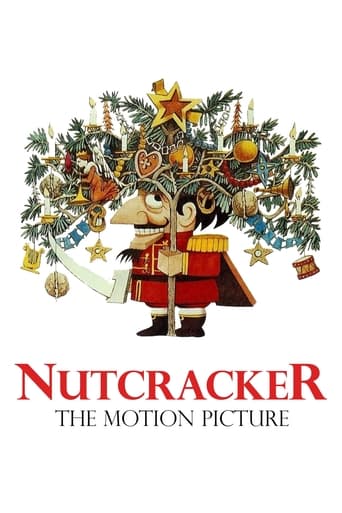
Nutcracker: The Motion Picture (1986)
A magnificent Christmas spectacular.
In this Pacific Northwest Ballet performance, it is Christmas Eve and festivities are underway. Clara is excited when her godfather arrives with a bag full of gifts, one of which is an intriguing wooden nutcracker. That night, while the household sleeps, Clara visits the Christmas tree to inspect her nutcracker and soon finds herself immersed in a dream world both dark and enchanting.
- Date of release
- 1986-11-26
- TMDB
- 6.7 / 10 (23)
- Runtime
- 1h 25m
- Genres
- Family, Fantasy, Music
- Director
- Carroll Ballard
Casting
- Hugh Bigney — Herr Drosselmeier / The Pasha
- Patricia Barker — Clara (after the battle) / Ballerina Doll
- Vanessa Sharp — Clara (Christmas party; battle scene)
- Wade Walthall — Nutcracker Prince
- Russell Burnett — Fritz
- Laura Schwenk — Snowflake
- Benjamin Houk — Father / Mouse King
- Beatrice Bassett — Grandparent
- Benjamin Bassett — Grandparent
- Julie Harris — Clara (Voice)
Interesting facts
- Based on: The Nutcracker and the Mouse King
Nutcracker: The Motion Picture, also known as Pacific Northwest Ballet's Nutcracker or simply Nutcracker, is a 1986 American Christmas performing arts film produced by Pacific Northwest Ballet in association with Hyperion Pictures and Kushner/Locke, and released theatrically by Atlantic Releasing Corporation. It is a film adaptation of 1892 ballet The Nutcracker by Pyotr Ilyich Tchaikovsky and the 1816 short story "The Nutcracker and the Mouse King" by E. T. A. Hoffmann.
Production
Pyotr Ilyich Tchaikovsky's popular 1892 ballet The Nutcracker is derived from E. T. A. Hoffmann's 1816 story The Nutcracker and the Mouse King. The ballet's scenario, crafted by Ivan Vsevolozhsky and Marius Petipa after a French adaptation by Alexandre Dumas, is far simpler and less nuanced than Hoffmann's original story.
Choreographer Kent Stowell, the artistic director of the Pacific Northwest Ballet (PNB), first invited the author-illustrator Maurice Sendak to collaborate on a Nutcracker production in 1979, after Stowell's wife and colleague Francia Russell saw a Sendak-designed performance of Mozart's The Magic Flute in Houston. Sendak initially rejected Stowell's invitation, later explaining:
The Nutcrackers I've seen have all been dull. You have a simpering little girl, a Christmas party, a tree that gets big. Then you have a variety of people who do dances that seem to go on and on ad nauseam. Technically it's a mess, too; Acts I and II have practically nothing to do with each other. ... What you don't have is plot. No logic. You have lots of very pretty music, but I don't enjoy it because I'm a very pedantic, logical person.
Stowell gave up for the moment, but contacted Sendak the following year, asking him to reconsider and suggesting that they "start from scratch." They began collaborating in earnest in 1981, developing a Nutcracker concept different from traditional productions, and closer to the themes in Hoffmann's original story.
PNB's Stowell/Sendak Nutcracker premiered in Seattle on December 13, 1983. It was a critical and popular success. Lincoln Kirstein, director of the New York City Ballet, called Sendak's production design "absolutely magnificent, and I was filled with a violent greed and envy." PNB continued to perform the Stowell/Sendak production annually for 31 years, ending in 2014; in 2015, the company premiered a production using George Balanchine's choreogr…
Read on Wikipedia · Text from Wikipedia, CC BY-SA 4.0. Data from Wikidata.
Recommended
- Babes in Toyland 1934 · ★ 6.3
- A Cinderella Story: If the Shoe Fits 2016 · ★ 7.2
- Alice's Adventures in Wonderland 1972 · ★ 6.3
- Cinderella 1997 · ★ 6.6
- Puss in Boots 1988 · ★ 7.0
- The Nutcracker 1993 · ★ 5.8
- Cinderella 1965 · ★ 6.5
- Frozen: The Hit Broadway Musical 2025 · ★ 7.8
- Beauty and the Beast: A 30th Celebration 2022 · ★ 6.8
- Fantasia 1940 · ★ 7.4
- Anastasia 1997 · ★ 7.6
- That Christmas 2024 · ★ 7.1